 On Nov. 23, 1984, a fire at Oxford Circus station - the busiest on London's Underground - trapped almost 1,000 passengers in smoke-filled tunnels for three hours. The flames started started in a storage room. Police officer Karen Tokins told the BBC: "People started to panic when they realized they could not get out."
February 27, 2008
OXFORD CIRCUS - 1984
On Nov. 23, 1984, a fire at Oxford Circus station - the busiest on London's Underground - trapped almost 1,000 passengers in smoke-filled tunnels for three hours. The flames started started in a storage room. Police officer Karen Tokins told the BBC: "People started to panic when they realized they could not get out."

February 26, 2008
RUM QUAY FIRE - 1933

 Photos: Port Cities London
On April 21, 1933, liquor-charged fire swept the Rum Quay at West India Docks and burned for four days. A main shed and vault were destroyed along with 6,500 puncheons - 3.1 million litres - of rum. The May 1, 1933 edition of Time Magazine said: ``Concussions rocked the warehouse and burning rum ran ... Blue flame fingered halfway across the Thames. London's brass-hatted firemen came by fireboat and engine. As the rum burnt, its evaporated alcohol made the firemen tipsy.'
FIREBOAT MASSEY SHAW


Photos: Little Ships Image Gallery
The fireboat Massey Shaw of the London Fire Brigade - named for Sir Eyre Massey Shaw, first chief officer of the Metropolitan Fire Brigade - is maintained today by a charitable trust. It was retired from active duty in 1971. Chief Shaw commissioned the city's first fireboats in the 1860s.
According to the web site of the television program Salvage Squad: ``Launched in 1935, the Massey Shaw was the first fireboat to be purpose-built for the Thames ... Two enormous diesel engines pushed the fireboat along at 12 knots. At the scene of the fire, these could be switched over to run two huge turbo pumps, pushing out over 3,000 gallons of Thames water per minute.
``The fireboat's first major call out or 'shout' was to the biggest fire London had seen for over 100 years. The rubber warehouse at Colonial Wharf burned for six days and was a difficult challenge for the new boat. But the Massey Shaw's pumping ability turned the boat into a hero. Working amongst the docks and wharves of the Port of London, the boat gained a place in the affections of Londoners.
``It was one of the craft that rescued troops in the Dunkirk evacuation at the beginning of the Second World War and fought fires throughout the London Blitz, playing a major role in saving St Paul's Cathedral.''
According to the web site Port Cities London, before the vessel's retirement, the Massey Shaw attended major fires at the Tate & Lyle works at Silvertown and aboard the Jumna at the Royal Albert Dock.
By 1866 - five years after Shaw took charge of London's fire service - two boats patroled the Thames. More ``fire floats'' joined the brigade's fleet.
In 1901, journalist Ernest A. Carr - writing in Living London, edited by George R. Sims - described the vessels in action: ``A message from the smaller station down at Blackwall intimates that a brig proceeding upstream has caught fire, and has been run aground … A strong glare of light round the next bend marks our objective, and a very few minutes more bring us abreast of the flaming vessel.
``There follow two hours of unremitting labour – aiding the crew of the fire-floats at their toil, taking wet lines aboard and fixing them to mooring posts and buoys, creeping down to windward of the flames to receive salvaged goods, and helping to fend the brig off by means of stout ropes into deeper water, where the volumes of water streaming in from the fire hose may submerge her.''
February 25, 2008
ORIGIN OF STOP MESSAGE

In the 19th Century novel ``Fighting the Flames,'' author R.M. Ballantyne provided a detailed description of the workings of the London Fire Engine Establishment - predecessor of today's London Fire Brigade. In one passage, he explained the origin of the ``stop message,'' which is broadcast today by radio to signal a fire is under control.
- When a fire occurred in any part of London at the time of which we write, the fire-station nearest to it at once sent out its engines and men, and telegraphed to the then head or centre station at Watling Street. London was divided into four districts, each district containing several fire stations, and being presided over by a foreman.
- From Watling Street the news was telegraphed to the foremen's stations, whence it was transmitted to the stations of their respective districts.
- While the engines were going to the fire at full speed, single men were setting out from every point of the compass to walk to it.
- In order, however, to prevent this unnecessary assembling of men when the fire was found to be trifling ... the fireman in charge of the engine that arrived first, at once sent a man back to the station with a `stop,` that is, with an order to telegraph to the central station ... and that all hands who have started from the distant stations may be `stopped.'
- Of course the man from each station had set out before that time, and the `stop' was too late for him, but it was his duty to call at the various fire stations he happened to pass on the way, where he soon found out whether he was to `go on` or to `go back.`
February 10, 2008
CAMDEN MARKET - 2008


 Photos: LFB and BBC
On Feb. 9, 2008, fire ravaged the stalls at Camden Town market, a major tourist attraction. Leaping flames - visible for miles - spread to the popular Hawley Arms pub and other buildings on a busy Saturday night. There were no serious injuries and the market reopened a week later.
Camden Town is ``a much-loved pocket of bohemia and a part of London where black eyeliner and tattoos usurp Savile Row threads as the urban uniform,'' according to The Scotsman newspaper.
An estimated 450 people were evacuated from the market and another 100 were moved from their homes.
According to a fire brigade press release: ``Twenty fire engines and around 100 firefighters were called to a fire on Chalk Farm Road in Camden. A range of market storage areas, shops, dwellings and two pubs were severely damaged by the blaze.'' An adjoining railway bridge and arches were also damaged.
Firefighters employed a hydraulic platform monitor, 15 jets, a variety of ground ladders and breathing apparatus.
Fire Station Manager Guy Foster, quoted by the BBC, said: "When firefighters arrived they found an intense fire. The decision was taken to clear a large area around the fire because we believed there were propane gas canisters in some of the market stalls.
``The police had to carry out a large operation to clear what is a very busy area on a Saturday night,'' Foster added.
The fire brigade received the alarm at 7:10 p.m., and the blaze was declared under control about six hours later. The cause of the fire wasn't immediately known. The first two engines arrived at the fire within minutes, according to reports.
According to The Evening Standard, Ruth Mottram, an owner of the Hawley Arms pub, was critical of the firefighters' response, saying: ``When our staff called the fire brigade the fire was a long way away from us.''
However, London Mayor Ken Livingstone, quoted by The Guardian, praised firefighters, saying: "Yet again the emergency services deserve our thanks for the speed and professionalism with which they have responded to tackle the blaze."
Val Shawcross, chair of the London Fire and Emergency Planning Authority, also offered praise, saying: ``London’s fire brigade demonstrated outstanding professionalism in bringing this difficult and dangerous fire under control, preventing it from spreading further and without a single casualty.
``Considering the fierce fire that fire crews found when they arrived at the incident we should recognise what a very good job they did in bringing it under control so quickly,” Shawcross said.
Assessing the aftermath, the BBC said: ``In all 90 stalls were damaged, 35 of them extensively. In addition six shops and the Hawley Arms have been affected.''
In a related incident, a double decker bus - diverted along Prince of Wales Road because of the fire at Camden market - crashed into a bridge on Feb. 11. The crash tore through the top deck of the bus and injured six people. One of the victims, a man, suffered severe head injuries, a police spokesman told the BBC.
February 08, 2008
BISHOPSGATE - 1964
UPDATED MAY 2013

 Early on Dec. 5, 1964, fire destroyed the Bishopsgate railway station, London's main freight terminal. Sixty pumps and 300 firefighters battled the blaze that illuminated the skies and killed two customs officials, Reuters reported. The United Press International wire service said the fire "engulfed drums ot gasoline and thousands of cases of bonded whisky.''
From U.K. Fire Service website

 Early on Dec. 5, 1964, fire destroyed the Bishopsgate railway station, London's main freight terminal. Sixty pumps and 300 firefighters battled the blaze that illuminated the skies and killed two customs officials, Reuters reported. The United Press International wire service said the fire "engulfed drums ot gasoline and thousands of cases of bonded whisky.''
From U.K. Fire Service website
At 06.20 on the morning of Saturday 5th December 1964 the London Fire Brigade received the first of many calls to a fire at Bishopsgate Goods Depot, in Shoreditch High Street, London E1.
This huge railway good depot which was built in 1880 then extended in 1914, and had a frontage of 300 ft. and went back to a depth of 600 ft. It was constructed of load bearing external walls. The floors where supported by internal unprotected cast iron columns at first and second floors, and by brick arch construction at ground floor level. Some of these arches that faced onto the street outside were let out for use as shops. The building was used to store a wide variety of commodities transported by British Rail. Many parts of the building contained Customs Cages where good were stored awaiting customs clearance.
Rail lines ran into the depot at first floor level to allow loading and unloading from railway goods wagons. Roadways also ran throughout the site allowing for to in order for motor lorries to transfer goods. Over 300 railway wagons and 60 motor vehicles were on the site when the fire started.
On receiving the first call by exchange telephone at a Pump Escape and Pump from Shoreditch, along with a Pump and Turntable Ladder from Whitechapel were ordered.
At 06.24 a second call was received again by exchange telephone to “Fire in the vicinity of the Goods Depot, Bishopsgate” followed by further calls at 06.25, 06.34, 06.39, 06.47, 06.48 and 06.58.
On receipt of the second call, the Pump Escape from Whitechapel was also ordered.
When the first appliance from Shoreditch arrived at the entrance to the depot in Shoreditch High Street, the OIC was greeted by the sight of smoke issuing from the widows at first and second floor levels. On turning into the road into the depot he could also see smoke issuing from all the first floor windows, and to a lesser extent, smoke also coming from all the second floor windows. The appliances pulled up outside a covered loading bank, and the Station Officer entered No. 5 loading bank. He made his way into the smoke filled building in a parallel direction to Bethnal Green Road and when around 25 yards in he saw a large area of fire in front of him and to his left. The fire appeared to extend right through to the Shoreditch High Street end. He could not see the side of the premises to Quaker Street due to thick dense black smoke.
He returned to his appliance where he immediately gave instructions to “Make Pumps 10”
Control received this message only 5 minutes after the original call whilst receiving the many other reports of fire. The Station Officer then ordered two braches to be got to work into the building by No. 5 bank and near to the loading platform. These jets were to be got to work from an internal hydrant situated on No. 5 bank. Having ensured these instructions were being followed he made his way to the gate where the appliances had entered and was met by a Security Officer who told him lighted embers were falling onto the ground floor from the first floor via an open lift shaft. Crews arriving dealt with these falling brands by the use of a branch that was got to work from the first floor.
Meanwhile at 06.24 Whitechapels Pump had arrived and drove up Wheler Street Hill into the Shoreditch High Street entrance at the first floor level where the railway lines were situated. The Officer in Charge of this appliance saw that the fire had spread throughout the building and that beyond the front bank loading platform, the building was well alight as far as he could see. He noticed that railway staff were fighting the fire from an internal hydrant using BR equipment in front of the offices.
At 06.30 the Pump Escape from Cannon Street arrived, and the officer in charge of this appliance gave orders for his pump to supply water to Whitechapels Pump. By now the whole of the building including the roof appeared to be ablaze. Drums of liquid within the building stared to burst. And the walls on the Commercial Street side of the building had started to crack. The combined efforts of crews from Whitechapel and Cannon Street enabled three branches to be got to work on the fire from the front loading bank.
The Officer in Charge of the first attendance had now returned to his own crews who had by this time got a branch to work and were laying a second, when a loud explosion on the second floor was heard. This was followed by a number of smaller explosions, also on the second floor.
The Station Officer now sent “Make Pumps 20”
Following these explosions the fire rapidly spread along the lines of railway goods wagons within the depot and onto the loading platforms on the first floor, and onto the warehouse on the floor above. The spread of fire was so rapid that the order to break couplings and move the two appliances was given to stop the appliances becoming involved in the fire. The appliance were moved, but not before the paint on them had become severely blistered. This didn’t affect the efficiency of the appliances and they continued to take part in the efforts to fight the fire. While the appliances were being moved the fire broke through the roof and a message was then sent “Make Turntable Ladders 3”
At 06.30 D.O. Lapthorne and A.D.O. Lloyd arrived at the fire. The D.O. went to the Wheler Street side and the A.D.O. to the Bethnal Green Road side of the building. The A.D.O. observed fire along around 300 ft. of windows on both first and second floor levels on the Bethnal Green Road side, so then went to the Shoreditch High Street side at first floor level where he found around 4/5ths of the first and second floors a mass of flames which was spreading quickly towards the loading bank.
At 06.36, D.O. Lloyd sent an informative message showing the building was well alight, followed at 06.33 for “A further 10 Pumps and 2 more Turntable Ladders” Both the A.D.O. and D.O. realised that conditions were becoming too dangerous for firefighters to remain in the building so gave the order for all crews to be withdrawn. The first major collapse of walls occurred moments later at 06.45 when a wall collapsed onto the Bethnal Green Road. Fortunately no crew or appliances were deployed where this collapse took place. Immediate actions were then taken to remove other appliances to a safe area. No sooner had this been accomplished that another collapse took place, this time where the appliances had been previously positioned. This second collapse caused a partial obstruction in Bethnal Green Road. It was now apparent that all firefighting would now have to be carried out from the perimeter of the site.
The message was now sent to “Make Pumps 40, with 10 Turntable Ladders” “10 Radial Branches” were also ordered. Jets were used to protect a 2,000 gallon petrol tank threatened during the fire and Whiskey in the bonded section added to the difficulties.
Due to strong winds, buildings in Quaker Street on the south side of the fire were threatened both by flying embers and radiated heat. A number of small fires did occur, but these were quickly dealt with, with no serious damage.
Jets were now concentrated in Wheler Street to enable the stop of fire spread to the South side of the goods depot, and to further protect property in Quaker Street. Turntable ladders were positioned at suitable vantage points, but were reinforced as soon as possible with Radial Branches
More jets were got to work from the main rail entrance at the first floor level to contain the fire in this area. These branches were slowly worked into the building with great care due to the fragile state of the building. At the height of the blaze, 21 jets and 8 Radial Branches were at work. At 07.59 the danger of further fire spread had been averted, and at 10.29 the stop was sent. Crews remained at the site cooling down and ensuring no re occurrence of fire took place.
Early in the fire the Station Officer in charge of the first attendance had questioned whether anyone was in the building. He was told that it was not known if anyone was in the building, but shortly later he was taken to a group of workers who had left and were now out of danger. Later at 07.13 a message was passed round the fire ground by radios that two Customs Officers might be in the building and were missing. The area they possibly were had collapsed and it was considered too dangerous to attempt a search, but it was noticed that a canopy hatch above the loading bay which served as an alternative escape route was open, so lent belief that they had escaped safely. Despite the instability of the area a search was later carried out and at 12.20 the bodies of the two Customs Officers were found.
It took 235 firefighters (including 17 AFS men) 22 Pumps, 19 Pump Escapes, 12 Turntable Ladders, 2 Emergency Tenders, 4 AFS Vehicles along with Control units, Wireless Cars and Staff Cars to bring this fire under control.
Apart from the loss of two lives, 300 railway wagons and 60 motor vehicles were severely damaged along with goods of all kinds that were in transit. The cost of the blaze was put at, at least five million pounds.
Radio Messages
0620: Call to “Fire at Bishopsgate Goods Depot”
0625: “From Stn/O Wheeler: Make Pumps 10.”
0629: “From Stn/O Wheeler: Make Pumps 20, TL’s 3.”
0628: “From Stn/O Wheeler: a building of five floors and basement, about 200’ x 200’ well alight.”
0643: “From DO Lapthorn: Make Pumps 30, TL’s 5.”
0647: “From DO Lapthorn: Make TL’s 6.”
0640: “From DCFO: Shortage of water. All rail lines to Liverpool Street Station to be closed.”
0657: “From CFO: Make Pumps 40.”
0700: “From CFO: Make TL’s 10.”
0707: “From CFO: Collect all radial branches and convey them to the fire.”
0713: Message passed round incident via fireground radios “Two Customs Officers believed still unaccounted for within the building”
0720: “From CFO: Considerable collapse of walls has taken place at North side of building. Personnel removed to safety Radial branches and TL’s at work. A number of small fires in surrounding property have been extinguished.”
0740: “From CFO: Some progress now being made to contain the fire.”
0742: “From CFO: Make Hose Layers 2.”
0759: “From CFO: Fire Surrounded.”
0820: “From Brigade Control to CFO: If more than 10 pumps are required as relief at 0900 hours, it will be necessary to get them from adjoining brigades. Please advise requirements.”
0832: “From DCFO: Numerous gas leaks. North Thames Gas Board urgently required.”
0842: From Brigade Control to DCFO: “From Information Room, Scotland Yard: Traffic is running over unprotected hose in Bethnal Green Rd.”
0845: “From DCFO: 20 pumps required as relief at 0900 from oncoming watch.”
0916: “From DCFO: Order on the Canteen Van.”
0920: “From ACFO: 100 gallons of diesel oil required.”
1029: “STOP.”
0625: “From Stn/O Wheeler: Make Pumps 10.”
0629: “From Stn/O Wheeler: Make Pumps 20, TL’s 3.”
0628: “From Stn/O Wheeler: a building of five floors and basement, about 200’ x 200’ well alight.”
0643: “From DO Lapthorn: Make Pumps 30, TL’s 5.”
0647: “From DO Lapthorn: Make TL’s 6.”
0640: “From DCFO: Shortage of water. All rail lines to Liverpool Street Station to be closed.”
0657: “From CFO: Make Pumps 40.”
0700: “From CFO: Make TL’s 10.”
0707: “From CFO: Collect all radial branches and convey them to the fire.”
0713: Message passed round incident via fireground radios “Two Customs Officers believed still unaccounted for within the building”
0720: “From CFO: Considerable collapse of walls has taken place at North side of building. Personnel removed to safety Radial branches and TL’s at work. A number of small fires in surrounding property have been extinguished.”
0740: “From CFO: Some progress now being made to contain the fire.”
0742: “From CFO: Make Hose Layers 2.”
0759: “From CFO: Fire Surrounded.”
0820: “From Brigade Control to CFO: If more than 10 pumps are required as relief at 0900 hours, it will be necessary to get them from adjoining brigades. Please advise requirements.”
0832: “From DCFO: Numerous gas leaks. North Thames Gas Board urgently required.”
0842: From Brigade Control to DCFO: “From Information Room, Scotland Yard: Traffic is running over unprotected hose in Bethnal Green Rd.”
0845: “From DCFO: 20 pumps required as relief at 0900 from oncoming watch.”
0916: “From DCFO: Order on the Canteen Van.”
0920: “From ACFO: 100 gallons of diesel oil required.”
1029: “STOP.”
January 31, 2008
CHANCE THE FIRE DOG
 Modern fire dog
The first canine officially documented as a fire dog was ``Chance'' of the London Fire Engine Establishment in 1828.
In a letter to the The Fireman magazine published in the 1800s, an old London fireman recalled: ``Fire after fire he attended until he was well known in London as 'Chance, the watermen firemen's dog.' Chance remained a faithful friend of the firemen for many years. He ultimately went nearly blind; even then he used to follow the engine,'' according to the book The Firefighters Best Friend.
While Chance wasn't a dalmation - his breed was never determined - ``he was known for following the crew to every fire and rescuing several people,'' the book said. ``He rotated throughout the firehouses in London, spending a few days at each house. As a result, every firefighter in London knew him.''
What's more, firemen took a collection to buy a brass dog collar with the inscription: ``Stop me not, but onward let me jog, for I am Chance, the London Firemen's dog.''
When he passed away, London newspapers published obituaries, and ``one paper reported that while on his deathbed, Chance tried unsuccessfully to rise up and follow the men one last time as they rushed to a fire,'' the book said.
After his passing ``his favorite house at the Central Station of the London Fire Brigade paid a taxidermist to stuff him and place him in a glass case,'' the book said. ``After the taxidermist completed his work, he decided to instead sell the famous dog to a showman on the other side of town, who let visitors glimpse the dog for a penny. The showman unknowingly allowed a fireman in for a viewing. Several hours later, the entire squad returned to retrieve their dog.''
The firemen mounted the case in the fire station, and placed a memorial plaque nearby that read: ``Chance, well known as the firemen's dog. Died October 10, 1835. This is humbly inscribed by the Committee of London Fire Establishment and their obedient servants.''
January 17, 2008
HEATHROW CRASH - 2008


 Photos: BBC and Press Association
British Airways Flight 38 from Beijing crash-landed short of a runway at London’s Heathrow Airport on Jan. 17, 2008. The airline said 136 passengers and 16 crew escaped on emergency slides. There were more than a dozen minor injuries. Airport firefighters applied blankets of foam to the wreckage to prevent leaking jet fuel from erupting in flame.
-
INCIDENT REPORT
12:43
G56 HEATHROW
AIRCRAFT ACCIDENT
HEATHROW AIRPORT, RVP SOUTH
G56 HEATHROW
AIRCRAFT ACCIDENT
HEATHROW AIRPORT, RVP SOUTH
1 Boeing 777 crash landed adjacent to runway. 136 passengers and 16 crew safely evacuated via escape chute. 11 casualties suffering minor injuries removed by L.A.S. 30-35 persons being assessed in triage at survivors reception centre. Foam blanket laid by Airport Fire Service and LFB. 1 Hose Laying Lorry, 3 Bulk Foam Units, 3 Airport Fire Service Foam Tenders,6 Foam Branches, 3500 litres of LFB foam used.
-
INITIAL DISPATCH
MOBILISE MOBILISE MOBILISE
INC. 9164081
TOC 12:43:43
TEL. REF MG AIRCRAFT CRASH, E3
@ AIRCRAFT ACCIDENT
@ RVP SOUTH
SOUTHERN PERIMETER ROAD
HAL
HOUNSLOW
MIDDLESEX
TW6
58.Q/98 G56 TQ 07468 74189
RUNWAY 27 LEFT
G561 @ G56 AS PA, 135, RTA, WMR, RT
G392 @ G39 AS PA, RTA
G401 @ G40 AS PA, 135, RTA, WMR
G382 @ G38 AS PA
G381 @ G38 AS PA
H431 @ H43 AS PA
G242 X RT @ G24 AS USRS
SR15 @ A34 AS USR
G306 @ A40 AS USRC, HRTA
H276 @ H27 AS USRC
E216 @ E21 AS USRC
H429 X RT @ H42 AS HLR
CU6 X PAG @ H43 AS CU
H387 @ H38 AS BFU, PM CARRYING BFU3
M20 @ H31 AS USM4, PMU CARRYING S044 USAR MODULE 4
M21 @ H31 AS USM1, PMU CARRYING S041 USAR MODULE 1
O20P X PAG @ O20 AS MRU
G104 X PAG @ G38 AS GM
G40 X PAG @ G56 AS SM
G23 X PAG @ G23 AS SM
G24 X PAG @ G24 AS HZ
E79 X PAG @ H39 AS UA
H42 X PAG @ H42 AS PR
January 03, 2008
ROYAL MARSDEN - 2008


INCIDENT REPORT
G34 - CHELSEA
25 PUMP PERSONS REPORTED FIRE
ROYAL MARSDEN HOSPITAL, FULHAM ROAD. SW3.
STOP MESSAGE: Hospital of 5 floors 100 metres x 50 metres, 50% of roof containing plant equipment and research labs damaged by fire. 79 patients and approximately 200 staff evacuated from building. 5 jets, 2 hosereels, 2 turntable ladders ,2 aerial ladder platforms, dry riser, extended duration breathing apparatus, turntable ladder monitor, thermal image camera, all persons accounted for, same as all calls.
By Vinny Del Giudice
London Fire Journal
On Jan. 2, 2008, a spectacular fire swept the roof and upper floors of one of the world's leading cancer hospitals - the Royal Marsden Hospital in central London. Twenty-five fire engines along with special units attended the blaze.
Founded in 1851 by Dr. William Marsden, the hospital treats 40,000 patients annually. In the 1920s, the Royal Marsden and the Institute of Cancer Research discovered that cigarette smoke was carcinogenic. In the 1950s, the hospital developed the first forms of chemotherapy.
Watch Manager Kevin Walpole, of the Chelsea fire station’s Red Watch, said: "There was fire in the left section of the roof and it was spreading rapidly because of the wind. One of our crews helped with the evacuation of the fifth floor while the other crew started tackling the fire and we quickly increased attendance to eight fire engines and other specialist equipment.”
Kensington Station Manager Martin Freeman reported: “The fire had spread into the roof space and was severe. Crews were working in arduous conditions and worked extremely hard. We do train for incidents like this and prepare evacuation strategies so we had a clear idea how to tackle this incident.”
Seniors fire officers worked with London water board ``turnkeys'' to ensure an adequate supply of water. The turnkeys respond to fires requiring six pumps or more.
In nearby Dovehouse Street, nurses attended to several patients on mattresses while others were led to safety wrapped in blankets and pushed in wheelchairs, according to a dispatch in The Scotsman newspaper.
Martin Gore, the hospital's medical director, said: "There were two patients having surgery at the time. They have been safely taken off their anaesthetic and ventilators. They were taken to recovery and are now in a neighbouring hospital. Some of the operations were partly interrupted and there may need to be some further surgery but the patients are safe."
Most everyone remained calm, evacuees said.
According to The Scotman newspaper, chemotherapy patient Paul O'Byrne, 50, reported: "We could see the smoke going past the window – it was really billowing past." Carole Williams, 55, standing in the street in a dressing gown, said: "There was no panic whatsoever."
Still, in an interview with BBC Radio 4, Valerie Shawcross, chair of London's fire and emergency planning authority, which oversee the fire brigade, was critical of the National Health Service. Enforcement notices have been served to almost two dozen NHS trusts since firefighters were given responsibility for hospital fire inspections across the U.K., Radio 4 said.
``I think it's very important that the rest of the health service looks at what's happened with the Royal Marsden,'' Shawcross said.``I think Fire Brigades up and down the country feel that they have been grappling to get the attention of the health service to improve their fire safety records and this really is the last chance warning to get on with it.'' Prime Minister Gordon Brown, his wife Sarah and Health Secretary Alan Johnson visited the Chelsea fire station the next day, and the prime minister told firefighters: “I was just at the Royal Brompton and all the patients thank you for your efforts.” Earlier, Brown said he had “nothing but the fullest of praise” for hospital staff and the emergency services.
The Salvation Army said its canteen was sent to the hospital as ``part of the official incident response'' and situated within the police cordon on Sydney Street, where it remained through the night. The canteen provides crews with refreshments and ``a listening ear.'' Said one patron: ``The little red van is like an oasis.''
The hospital reopened to outpatients on Jan. 7.
CUTTY SARK - 2007
On May 27, 2007, flames damaged the 19th Century ship Cutty Sark - the historic tea clipper at its drydock in William Walk, Greenwich. Forty firefighters, eight pumps and an aerial ladder battled the blaze. Built in 1869, Cutty Sark was the last clipper constructed as a merchant vessel. She went on public display in 1954. Investigators determined the fire was caused by an electrical fault in a vacuum cleaner.
May 02, 2007
INCIDENTS OF NOTE
 Iron Mountain warehouse - July 2006

Fire on Oxford Street - April 2007
Photos: BBC
List of incidents of note:
Feb. 9, 2008 - Camden Market. 20 pumps.
Jan. 17, 2008 - British Airways Flight 38 crash landing at Heathrow.
Jan. 2, 2008 - Royal Marsden Hospital, 25 pumps. 79 patients evacuated.
Aug. 29, 2007 - Standard Road, Park Royal. 15 pumps.
June 29 and July 1, 2007 - Two 20-pump fires at University of Westminster, Watford Road, Harrow, days apart. The first fire involved gas cylinders, the second involved classrooms, the BBC said.
May 21, 2007 - Cutty Sark, King William Walk, Greenwich. 8 pumps.
April 26-27, 2007 - Oxford Street shops. 30 pumps.
Feb. 19, 2007 - Albert Court, Kensington Gore, South Kensington. 30 pumps.
Oct. 4, 2006 - Pellet Yard, Nobel Road. 20 pumps.
July 12, 2006 - A pair of 20-pump fires on the same day at Aerodrome Road and Iron Mountain, Twelvetrees Crescent, Bow.
July 16, 2005 - Staples Corner, Cricklewood. 20 pumps.
July 14, 2005 - Factory fire. VDC House, South Way, Wembley. 30 pumps. Stadium construction site evacuated as precaution.
July 7, 2005 - Transit bombings. More than 50 dead. 700 injured. Edgware Road Underground Station, 12 pumps; Kings Cross Underground, 12 pumps; Aldgate Underground, 10 pumps.
Sept. 6, 2004 - Chasewood Park, Sudbury Hill, Harrow. 20 pumps.
July 20, 2004 - 419 Bethnal Green Road, London. 2 firefighters killed. 8 pumps.
April 30, 2004 - 145 Coles Green Road, Cricklewood. 20 pumps.
April 27, 2004 - Flash floods. Fire brigade receives more than 1,000 calls.
Aug. 7. 2003 - Stonefield Way, South Ruislip. 20 pumps.
July 29, 2003 - Telstar House, Eastbourne Terrace, Paddington. 20 pumps.
June 2, 2003 - Waitrose, Bullards Lane, Finchley. 20 pumps.
Sept. 2, 2002 - Seven people rescued from hostel fire. Montagu Place, Marylebone. 8 pumps.
Aug. 7 2002 - Lightning storms strike London. Fire brigade receives 1,400 calls.
July 29, 2002 - West London & Ealing College, The Green. 20 pumps.
June 6, 2002 - Buckingham Palace. 20 pumps.
Aug. 24, 2001 - Mays Transport, Hindsman Way, Dagenham. 20 pumps.
Oct. 22, 2000 - Zotefoams, Mitcham Road, Croydon. 30 pumps.
July 16, 2000 - The Big Yellow Storage, 100 Garratt Lane. 30 pumps.
Oct. 5, 1999 - Paddington rail disaster, Barlby Road. 12 pumps.
Sept. 2, 1999 - 40 Earlham St. 20 pumps.
July 19, 1999 - Ferry Lane, Rainham. 20 pumps.
April 30, 1999 - Bombing at Admiral Duncan Public House, Old Compton Street
Jan. 4, 1998 - Sahib Foods, 163 Brent Road, Southall. 20 pumps.
Dec. 12, 1997 - Heathrow Airport, Terminal One. Hundreds of flights delayed, diverted or cancelled. 15 pumps.
Nov. 15, 1996 - Selsdon Court, Dormers Rise, Southall. 20 pumps.
Sept. 22, 1996 - Mill Lane, Waddon, Croydon. 20 pumps.
Feb 18, 1996 - Bombing aboard bus in West End.
Feb 10, 1996 - Bombing at Docklands.
Feb. 2, 1996 - Two major fires. Marsh Wall, 20 pumps. Kwikfit, The Hyde, Edgware Road, 15 pumps.
Jan. 17, 1996 - Natwest Tower. Roof fire. 500 calls received at "999."
Aug. 24, 1993 - Bombing at Bishopsgate, City of London. 20 pumps.
April 10, 1992 - Bombing at St. Mary Axe, City of London. 3 civilian deaths.
July 21, 1990 - Bombing at London Stock Exchange.
March 31, 1990 - Poll Tax Riot, Trafalger Square.
Feb. 12, 1990 - Savoy Theatre.
Aug. 20, 1989 - Sinking of Marchioness. 51 dead.
Dec. 12, 1988 - Chapham Junction rail disaster.
Nov. 18, 1987 - King's Cross underground. 31 dead, including Soho Station Officer Colin Townsley.
March 31, 1986 - Hampton Court Palace.
Dec. 17, 1983 - Harrod's, central London. 6 dead, 90 injured.
July 27, 1982 - Civil Service Building, The Strand. 20 pumps.
July 20, 1982 - Bombs at Hyde Park and Regents Park. 11 dead, 50 injured.
Jan. 18, 1981 - House fire, New Cross Road, Deptford, 13 dead.
Aug. 16, 1980 - 37 dead in club fire in Soho.
July 10, 1980 - Alexandra Palace.
April 27, 1980 - Old Caledonian ship fire on Thames. 15 pumps.
Jan. 26, 1979 - Villiers House. 40 pumps.
Nov. 1, 1978 - The Granary, Camley Street. 35 pumps. Firefighter Stephen Neil of Barbican station killed when wall collapsed on fire engine.
March 15, 1976 - Bombing on Hammersmith & City line train near West Ham.
Jan, 29, 1976 - Series of bombings in West End.
Sept. 5, 1975 - Bombing at London Hilton.
Feb. 28,1975 - Moorgate Underground Station. Train from Drayton Park plowed into dead-end tunnel, killing more than 40 people during morning rush hour.
Dec. 13, 1974 - Worsley Hotel, Maida Vale. 7 people die, including probationary firefighter Hamish Petit.
Oct. 22, 1974 - Bombing at Brooks Club.
July 17, 1974 - Bombing at Tower of London.
June 17, 1974 - Bombing at Westminister Hall.
Sept. 10, 1973 - Bombings at Kings Cross and Euston stations.
May 22, 1972 - Gardiner's Corner, Whitechapel. Fully involved shop and office block.
Oct. 31, 1971 - Bombing at Post Office Tower.
Aug. 9, 1971 - Riverside warehouse, Battlebridge Lane, near Tooley Street. 40 pumps.
July 17, 1969 - Tank farm at Dudgeons Wharf, the Isle of Dogs. 5 firefighters killed.
June 6, 1969 -Leinster Towers Hotel, Bayswater. Multiple ladder rescues. 30 pumps.
Nov. 5, 1967 - Hither Green rail disaster.
Sept. 22, 1966 - Bambergers Timber Yard, Grovelands Road, Tottenham. 30 pumps.
Sept. 22, 1965 - Grocers' Hall, City of London. 30 pumps.
Dec. 5, 1964 - Bishopsgate railway station. 60 pumps.
Aug. 11, 1960 - Tube fire at Redbridge.
July 28, 1958 - Tube fire at Holland Park.
Jan. 23, 1958 - Union Cold Storage Co. at Smithfield Market. 2 firefighters killed. More than 1,000 firefighters attended the incident.
Dec. 4, 1957 - Lewisham rail disaster.
Oct. 5, 1954 - Fire destroyed top floor of Royal Mail Mount Pleasant Sorting Office, Clerkenwell.
May 11, 1954 - Fruit and vegetable warehouse at Covent Garden. 3 firefighters killed.
April 8, 1953 - Rear-end collision of two Central Line trains in tunnel between Stratford and Leyton. 12 civilians killed.
Jan. 19, 1951 - Eldon Street warehouse fire and collapse. 3 firefighters killed. 22 other injured, including C.P. McDuell, deputy chief fire officer whose leg was amputated.
Dec. 31, 1946 - Two Metropolitan Line trains collide in fog near Northwood, causing fire. 3 dead.
Nov. 25, 1944 - Deadliest of German V2 rocket attacks. Woolworths, New Cross. More than 160 dead.
Nov. 16, 1940 - Wandsworth fire station demolished in air raid, killing six firefighters -- W. Brum, L. Isaacs and W. Beard, died on watch, and A. Turner, C. Andreazzi and D. Aust, died in recreation room. Firefighters L. Aylett and E. Bowler survived, resting under billiard table.
Oct. 7, 1940 - Soho fire station in central London received direct hit in air raid, killing Station Officer William Wilson and Auxiliary Firefighter Frederick Mitchell.
Sept. 7, 1940 to May 15, 1941 - The Blitz, World War II. Widespread aerial bombardment by Germany. Thousands killed, including more than 300 regular and auxiliary firefighters. Buckingham Palace, alone, suffered nine direct hits during attacks.
July 26, 1939 - IRA bombs explode at Kings Cross and Victoria stations.
May 17, 1938 - Two District Line trains collide near Charing Cross, 6 dead.
Dec. 27, 1937 - HMV Record Shop, Oxford St.
Nov. 30, 1936 - Crystal Palace.
March 7, 1936 - Surrey Commercial Docks.
Sept. 27, 1935 - Colonial Wharf, Wapping High Street. 60 pumps. Burned for four days.
Nov. 16, 1934 - Top floors of office building, Farringdon St., near Ludgate Circus.
1925 - Madame Tussauds wax museum.
Jan. 30, 1918 - Pepper Mills, Vauxhall. Fire and collapse. 7 firefighters killed.
Jan. 20, 1917 - Munitions plant explosion. 50 dead. 100 injured.
Aug. 24, 1916 - Zeppelin aerial bombardment, World War I.
August 1911 - Carlton Hotel.
Dec. 20, 1909 - Arding and Hobbs department store, near Clapham Junction, destroyed by fire.
June 9, 1902 - Queen Victoria Street. 8 civilians, beyond reach of fire brigade ladders, die.
April 12, 1902 - Commercial buildings, Barbican.
July 12, 1901 - West India Docks.
Nov. 19, 1897 - Cripplegate fire damages 100 buildings, primarily warehousing.
May 8, 1892 - Scott's Oyster Bar, Coventry Street. 4 dead.
Dec. 30, 1890 - Fire sweeps four commercial blocks in vicinity of Queen Victoria and Thames streets near Blackfrair's Bridge.
Oct. 13, 1890 - Rowley & Brock hat factory, Middle Street. 11 dead. Many injured.
Oct. 30, 1883 - First known bombings on London Underground, between Charing Cross and Westminster and at Paddington Praed Street. 60 people injured.
Aug. 14, 1883 - Fire in lunatic asylum, Southall Park. Six dead, including Dr. Robert Boyd.
Dec. 7, 1882 - Alhambra Theatre, Leicester Square. 2 firemen killed. HRH George, Prince of Wales - honorary firefighter - almost killed by falling wall.
Oct. 1, 1869 - Fireworks explosion. 69 Moscow Road, Bayswater. 7 dead.
June 23, 1861 - Warehouse at Cotton’s Wharf, Tooley Street. James Braidwood, chief of insurance industry's London Fire Engine Establishment, killed by falling wall. Incident led to organization of municipal fire service.
Oct. 30, 1841 - Tower of London.
Jan. 10, 1838 - Royal Exchange.
Oct. 16, 1834 - Houses of Parliament destroyed. Records show 64 men and 12 engines attended fire.
Sept. 2-Sept. 5, 1666 - Great Fire of London. Four fifths of London destroyed.
June 06, 2006
MOORGATE DISASTER - 1975


 Photos: British Medical Journal and BBC
On Feb. 28, 1975, more than 40 people died when a train - arriving at the Moorgate Underground station from Drayton Park - overshot the platform and crashed into a dead-end tunnel during the morning rush hour. The last survivor wasn't freed from the carnage of ``the 8:37'' until evening.
``If there's a hell, I've lived to see it,'' a doctor was quoted as saying.
On the 25th anniversary of the wreck, Peter Woodman of the Press Association wrote that the rescue and recovery went on for six days, with more than 1,300 firefighters, 240 police officers, 80 ambulance attendants and 16 physicians ``on the spot'' - along with hospital staff and volunteer services.
The six-car train was built in 1938, and operated a two-and-a-half mile shuttle from Drayton Park, calling at Highbury and Essex Road stations, Woodman wrote. It slammed into the 5 foot thick wall at speed - roughly 35-40 mph.
Rescuers spoke of the ``raw courage'' of Policewoman Margaret Liles, 19, a passenger in the first carriage, who was freed after more than 12 hours - after doctors amputated one of her feet.
Conditions in the tunnel tested the emergency services. "The air is so bad that the doctors have decreed that everybody working down there must wear breathing masks," said a police spokesman, quoted by the Yorkshire Post.
Among the dead was train driver Leslie Newson, 55.
Known as careful and conscientious, Newson ``had been in good health and had not taken any alcohol or drugs, and was considered an unlikely suicide candidate,'' the BBC said.
The cause of the Moorgate disaster remains a mystery. ``Nothing was wrong with the train, the signalling equipment or the track, '' according to the BBC, though London Underground introduced new safety measures after the wreck.
____
British Medical Journal - June 3, 2000
Railway signals passed at danger: psychology matters
Glin Bennet, formerly senior lecturer and consultant psychiatrist
Bristol
Seventy five per cent, eighty per cent. Over the years this is the seemingly unvarying proportion of transport accidents ascribed to human factors. Investigations are meticulous, the engineers take care to see that every nut and bolt is studied, yet so often the conclusion is the same: “human failure.”
This seems to be accepted as an explanation, and with it the matter can be closed. For any psychiatrist, reports of odd behaviour, such as driving a car or a train through a red light, are merely the beginning of an investigation, a warning that there may be problems below the surface.
In the aftermath of the Paddington rail disaster in October 1999, attention has been focused on signalling systems, and rightly so. The assumption seems to be that if the signals and points can all be made reliable then accidents should cease. But that does not explain the 600 or so signals passed at danger each year in the United Kingdom.
There is nothing new in all this, as Professor R A Cocks has pointed out (BMJ 1999;319:1018-9). In the 1940s and 1950s the late Professor Derek Russell Davis published research on the human factors which lead to accidents. His researches into rail incidents, usually signals passed at danger, were made with the full cooperation of British Rail, and in private interviews drivers spoke openly to him about their behaviour in the accidents, their anxieties, and distracting worries.
In my own studies of small boat sailors, airline pilots, train drivers, and motorists, numerous examples emerged of psychological processes which can lead to accidents. For example, seeing the signal that you want to see, in the colour that you want, not what is actually there (Lewisham train disaster, 1957—90 dead; Norton Fitzwarren, 1940—27 dead; perhaps also Harrow and Wealdstone, 1952—112 dead). Sailors can misread lights in the same way.
Preoccupation with matters remote from the scene may account for some of the 600. At the Hayward's Heath accident in 1973 the driver misread the signals and drove his loopline train on to the main line and it was struck from behind by an express. This driver was reported as going through a divorce at the time, had financial worries, and a stomach ulcer. In November 1981 the driver of a commuter train was involved in a collision from misreading the signals. He was evidently dosing himself with pain killing drugs for an aching wisdom tooth, his wife had just given birth to their first child, and his mother was suffering from cancer.
The Moorgate underground train disaster in 1975, 43 killed, was never satisfactorily explained, or possibly was never satisfactorily investigated. The medical experts involved gave speculative diagnoses that the driver (who was killed) was suffering from “akinesis with mutism” or “transient global amnesia.” I know nothing of these as acute conditions, but I would have wanted to inquire more into the unfortunate driver's circumstances.
The reports of inquiries that I have read tended to be chaired by military men, with a robust approach to mechanical detail and not much interest in psychological processes. There is also the subtle British resistance to looking into the psychological process of others, because of the unspoken acknowledgment from so doing that you might have a vulnerable psyche yourself, and that would not do. Fortunately, the drivers of most rail incidents survive, unlike their colleagues in the air, and so there is a real opportunity to learn about the causes of the 75% or 80% of transport accidents. In fact the railways are excellent laboratories for such studies, and they have a relevance to all modes of transport.
Improvements in signalling and track are important, of course, but the drivers are also important. These people can confound safety devices when they fall victim to adverse psychological processes, and if we are not going to opt for driverless trains we need to understand more about the drivers.
January 17, 2006
KEY DATES

From London Fire Brigade web site
63AD Vigiles appointed to look out for fires at night by Roman Emperor, Augustus.
440 After the Romans’ departure, no organised fire service for over 120 years.
1212 London Bridge burnt down. This was known as Great Fire of London until 1666. Allegedly 12,000 people died, although this figure could have been exaggerated.
1556 Act of Parliament laid down that ‘Bellmen’ should be appointed to walk the streets at night to raise alarm if fire spotted.
1666 Great Fire of London. 13,200 homes, 87 churches, 423 acres and four fifths of London destroyed.
1667 First fire insurance company established by Nicholas Barbon.
1668 Common Council decides that the City and Liveries (the inner suburbs) will be divided into four areas, each having 800 leather buckets, 50 ladders, 24 pick-axe hatchets and 40 shovels.
1680 First fire brigade formed by Barbon’s Fire Office.
1708 Parish Pumpers Act passed by Parliament, the first piece of fire prevention legislation, thus changing building regulations and establishing parish fire brigades.
1774 Act of Parliament passed resulting in the City of London having 218 engines with 80 in the rest of London.
1833 Formation of the London Fire Engine Establishment on 1st January by an amalgamation of 10 insurance company fire brigades under the leadership of James Braidwood. 19 fire stations and 80 firemen.
1834 Fire at Westminster Palace burns down the majority of the original Houses of Parliament. 64 men and 12 engines attended.
1836 Formation of the Royal Society for the Protection of Life from Fire created to provide fire escape ladders throughout London.
1838 Fire at the Royal Exchange.
1841 Fire at the Tower of London.
1848 The first ball hydrants installed.
1860 London buys its first land steam fire engine.
1861 Fire at Tooley Street. James Braidwood killed. Fire costs insurance companies over £2 million, leading them to threaten to disband the London Fire Engine Establishment. Captain E.M Shaw takes over L.F.E.E.
1865 Metropolitan Fire Brigade Act passed, setting up the Metropolitan Fire Brigade under the authority of the Metropolitan Board of Works. Parish fire brigades in London disbanded, insurance companies relieved of their firefighting ‘duties.’
1866 Metropolitan Fire Brigade forms on 1st January under Captain Shaw. London has 17 land and 2 floating stations. New uniform introduced including brass helmet and navy blue tunic.
1867 MFB take over the fire escape ladders of the Royal Society for the Protection of Life from Fire. The Siemen Halske’s telegraph system is introduced to enable easy communication between stations.
1870s Firemen’s pay ranges between £1 4s 6d and £1 15s 0d.
1871 Death of Fireman Ford at Gray’s Inn Road. A public outcry forces the Metropolitan Board of Works to award a pension to his widow, which was subsequently taken away after a public fund for her raised ‘too much’ money.
1875 The London Auxiliary Fire Brigade is formed by Shaw to help solve chronic manpower problems.
1880 Shaw starts his massive survey of London theatres in an attempt to curtail the number of fatal theatre fires. The first system of street alarm posts is introduced. Telephones also introduced around this time.
1882 Alhambra Theatre Fire, Leicester Square. Prince of Wales (amateur fireman) nearly killed by falling wall.
1889 London County Council formed and takes over the MFB. London has 55 land and 4 floating stations.
1891 Captain Shaw retires from post of Chief Officer, his place taken over by James Sexton Simmonds.
1892 The Brigade numbers 825 men and costs £128,783 per year to run.
1894 London has 57 land and 4 floating stations.
1896 Simmonds forced to resign as CFO because of financial impropriety. Captain Wells takes over as CFO.
1897 Wheeled escape ladders begin to be mounted on horsed carriers for the first time. November, the Cripplegate fire in the City destroys 100 buildings at a cost of £1 million.
1898 The Brigade is now answering an average of 10 calls per day.
1899 Firemen no longer recruited exclusively from the Royal and Merchant Navies but ex-sailors continue to be preferred until the Second World War.
1900 Launch of ‘Alpha II’ - London’s first self-powered fire boat.
1902 Queen Victoria Street fire in the City, 9 are killed. The ladders were too short to reach the top floors, leading to much criticism of the Brigade. Hook ladders and longer escape ladders are introduced as a result.
1903 Captain Wells retires, Rear Admiral Hamilton takes over as CFO.
1904 Metropolitan Fire Brigade is renamed London Fire Brigade. London introduces its first motorised vehicles.
1905 First turntable ladder introduced, reaching to 82 feet.
1906 First motor escape vans introduced.
1909 Rear Admiral Hamilton retires and is succeeded by Lieutenant Commander Sladen. First pumping appliance entirely driven by motor engine introduced.
1913 London has 85 land and 3 river stations. First use of self-contained oxygen breathing apparatus.
1914 Outbreak of the First World War, one fifth of the LFB are in the navy reserve and are recalled for service, causing a manpower crisis.
1918 Fire and collapse at Albert Embankment results in the death of seven firemen. One other also killed in an accident made this the greatest loss of life on one day outside the war. Sladen retires as CFO and is replaced by Arthur Dyer.
1920 Two watch system introduced, reducing the working week to 72 hours; firemen are no longer required to live in the stations.
1921 Motorisation of the LFB completed, the last two horses are retired from Kensington Fire Station.
1933 Dyer retires as CFO and is replaced by Major Cyril Morris.
1934 Introduction of the ‘Dual Purpose’ appliance, which combines pumping with escape carrying machines.
1937 The Civil Defence Act is passed that enables local authorities to raise an Auxiliary Fire Service. Initial plans in London call for a force of 28,000 Auxiliary Firemen and Firewomen. London has 59 land and 3 river stations.
63AD Vigiles appointed to look out for fires at night by Roman Emperor, Augustus.
440 After the Romans’ departure, no organised fire service for over 120 years.
1212 London Bridge burnt down. This was known as Great Fire of London until 1666. Allegedly 12,000 people died, although this figure could have been exaggerated.
1556 Act of Parliament laid down that ‘Bellmen’ should be appointed to walk the streets at night to raise alarm if fire spotted.
1666 Great Fire of London. 13,200 homes, 87 churches, 423 acres and four fifths of London destroyed.
1667 First fire insurance company established by Nicholas Barbon.
1668 Common Council decides that the City and Liveries (the inner suburbs) will be divided into four areas, each having 800 leather buckets, 50 ladders, 24 pick-axe hatchets and 40 shovels.
1680 First fire brigade formed by Barbon’s Fire Office.
1708 Parish Pumpers Act passed by Parliament, the first piece of fire prevention legislation, thus changing building regulations and establishing parish fire brigades.
1774 Act of Parliament passed resulting in the City of London having 218 engines with 80 in the rest of London.
1833 Formation of the London Fire Engine Establishment on 1st January by an amalgamation of 10 insurance company fire brigades under the leadership of James Braidwood. 19 fire stations and 80 firemen.
1834 Fire at Westminster Palace burns down the majority of the original Houses of Parliament. 64 men and 12 engines attended.
1836 Formation of the Royal Society for the Protection of Life from Fire created to provide fire escape ladders throughout London.
1838 Fire at the Royal Exchange.
1841 Fire at the Tower of London.
1848 The first ball hydrants installed.
1860 London buys its first land steam fire engine.
1861 Fire at Tooley Street. James Braidwood killed. Fire costs insurance companies over £2 million, leading them to threaten to disband the London Fire Engine Establishment. Captain E.M Shaw takes over L.F.E.E.
1865 Metropolitan Fire Brigade Act passed, setting up the Metropolitan Fire Brigade under the authority of the Metropolitan Board of Works. Parish fire brigades in London disbanded, insurance companies relieved of their firefighting ‘duties.’
1866 Metropolitan Fire Brigade forms on 1st January under Captain Shaw. London has 17 land and 2 floating stations. New uniform introduced including brass helmet and navy blue tunic.
1867 MFB take over the fire escape ladders of the Royal Society for the Protection of Life from Fire. The Siemen Halske’s telegraph system is introduced to enable easy communication between stations.
1870s Firemen’s pay ranges between £1 4s 6d and £1 15s 0d.
1871 Death of Fireman Ford at Gray’s Inn Road. A public outcry forces the Metropolitan Board of Works to award a pension to his widow, which was subsequently taken away after a public fund for her raised ‘too much’ money.
1875 The London Auxiliary Fire Brigade is formed by Shaw to help solve chronic manpower problems.
1880 Shaw starts his massive survey of London theatres in an attempt to curtail the number of fatal theatre fires. The first system of street alarm posts is introduced. Telephones also introduced around this time.
1882 Alhambra Theatre Fire, Leicester Square. Prince of Wales (amateur fireman) nearly killed by falling wall.
1889 London County Council formed and takes over the MFB. London has 55 land and 4 floating stations.
1891 Captain Shaw retires from post of Chief Officer, his place taken over by James Sexton Simmonds.
1892 The Brigade numbers 825 men and costs £128,783 per year to run.
1894 London has 57 land and 4 floating stations.
1896 Simmonds forced to resign as CFO because of financial impropriety. Captain Wells takes over as CFO.
1897 Wheeled escape ladders begin to be mounted on horsed carriers for the first time. November, the Cripplegate fire in the City destroys 100 buildings at a cost of £1 million.
1898 The Brigade is now answering an average of 10 calls per day.
1899 Firemen no longer recruited exclusively from the Royal and Merchant Navies but ex-sailors continue to be preferred until the Second World War.
1900 Launch of ‘Alpha II’ - London’s first self-powered fire boat.
1902 Queen Victoria Street fire in the City, 9 are killed. The ladders were too short to reach the top floors, leading to much criticism of the Brigade. Hook ladders and longer escape ladders are introduced as a result.
1903 Captain Wells retires, Rear Admiral Hamilton takes over as CFO.
1904 Metropolitan Fire Brigade is renamed London Fire Brigade. London introduces its first motorised vehicles.
1905 First turntable ladder introduced, reaching to 82 feet.
1906 First motor escape vans introduced.
1909 Rear Admiral Hamilton retires and is succeeded by Lieutenant Commander Sladen. First pumping appliance entirely driven by motor engine introduced.
1913 London has 85 land and 3 river stations. First use of self-contained oxygen breathing apparatus.
1914 Outbreak of the First World War, one fifth of the LFB are in the navy reserve and are recalled for service, causing a manpower crisis.
1918 Fire and collapse at Albert Embankment results in the death of seven firemen. One other also killed in an accident made this the greatest loss of life on one day outside the war. Sladen retires as CFO and is replaced by Arthur Dyer.
1920 Two watch system introduced, reducing the working week to 72 hours; firemen are no longer required to live in the stations.
1921 Motorisation of the LFB completed, the last two horses are retired from Kensington Fire Station.
1933 Dyer retires as CFO and is replaced by Major Cyril Morris.
1934 Introduction of the ‘Dual Purpose’ appliance, which combines pumping with escape carrying machines.
1937 The Civil Defence Act is passed that enables local authorities to raise an Auxiliary Fire Service. Initial plans in London call for a force of 28,000 Auxiliary Firemen and Firewomen. London has 59 land and 3 river stations.
(June 30, 1937 - ``999'' emergency telephone service introduced in London. - Editor)
1938 The Fire Brigades Act is passed which formally requires all local authorities (except London) to have fire brigades. There are over 1,600 fire Brigades in the UK. CFO Morris retires and is aptly replaced by Commander Firebrace.
1939 Recruitment, training and equipping of AFS begins to advance rapidly. AFS mobilised on 1st September, London compiles a force of 23,000 Auxiliaries. There are over 300 AFS sub-stations. War declared on 3rd September. Commander Firebrace is seconded to the Home Officer, leaving DCO Jackson in command of the LFB.
1940 June: fireboat Massey Shaw is used in the evacuation of troops from Dunkirk. August: Battle of Britain. 7th September: the Blitz hits begin; London is hit on 57 consecutive nights. 17th September: Harry Errington saves several colleagues from a burning shelter and thereby earns the George Cross. 29th December: firebomb attack on the City creates the “Second Great Fire of London.”
1941 10/11th May: massive attack on London, 17 firemen killed at St George’s Circus. 15th May: Blitz finishes. 18th August: nationalisation of the British Fire Service forming the National Fire Service (NFS); for the first time there is standardisation of organisation, ranks, equipment, drills, etc.
1944 June: V1 (flying bomb) attacks begin with London receiving 99 flying bombs on August 3rd. The fire service becomes fully committed to rescue and firefighting duties. September: V2 (missile) attacks commence.
1945 May: the Second World War ends and the fire service begins to downsize. August: Fireman Frederick Davies wins the George Cross for attempting the rescue of two girls in Harlesden, after which he died.
1948 The fire service is de-nationalised; control of the London Fire Brigade passes back to the LCC. Frederick Delve becomes Chief Officer. London has 58 land and 2 river stations.
1949 The Auxiliary Fire Service is re-established.
1951 November: first ever refusal of labour by London’s firefighters: only emergency calls answered in a dispute that called for parity with police pay. December: Broad Street fire, 3 firemen are killed and the DCO seriously injured.
1957 Lewisham train crash: 85 people killed.
1958 January: fire in Smithfield Market; StnO Fourt-Wells and Ff Stocking get lost in the cellars and die - the BA control system is brought in as a result. The last street alarm post is removed from London.
1962 CFO Delve retires and is replaced by Leslie Leete.
1965 The Greater London Council is created; the LFB expands to meet the borders of the GLC, and, in doing so, takes over the Middlesex, Croydon, West and East Ham Brigades plus large areas of Surrey, Kent, Essex and Hertfordshire. London now has 115 land and 2 river stations.
1966 The Brigade celebrates its centenary with a Queen’s review at Lambeth.
1967 Hither Green rail crash.
1968 The Auxiliary Fire Service is disbanded.
1969 July: explosion at Dudgeons Wharf kills five firemen - the greatest loss of London firefighters in a single incident since the war.
1970s The HAZCHEM system is designed and implemented.
1970 CFO Leete retires and is replaced by Joseph.
1974-75 Compressed air breathing apparatus is introduced.
1974 A massive recruitment campaign takes place and training centres are set up around London.
1975 The Moorgate Tube disaster presents the Brigade with one of its most complex challenges.
1976 CFO Milner retires and is replaced by Peter Darby.
1977 Fireman’s strike.
1979 The Green Watch is created, thus lowering the working week from 48 to 42 hours.
1980 CFO Darby retires and is replaced by Ronald Bullers.
1982 Sue Batten becomes London’s, and Britain’s, first female firefighter.
1986 The GLC is abolished - control of the LFB passes to the London Fire and Civil Defence Authority (LFCDA).
1987 CFO Bullers retires and is replaced by Gerald Clarkson. November: fire at King’s Cross Underground Station, StnO Townsley is among those that died.
1988 Clapham rail disaster.
1989 Introduction of Nomex firecoat finally replaces the blue wool fire tunic. This is shortly followed by Nomex leggings and Kevlar helmet, all introduced after shortcomings discovered at King’s Cross.
1991 Clarkson retires and is replaced by Brian Robinson. Automatic Distress Signal Units introduced for breathing apparatus.
1992 A mobile data system introduced enabling some officers to send information from appliances.
1995 London has 113 land and 1 river station.
1997 Draeger PA94 Plus model breathing apparatus introduced.
1998 London has 111 land and 1 river station.
1999 Introduction of the ‘Inferno’ fire uniform. LFB first brigade to use this. October: Paddington rail disaster.
2000 The change of local authority means LFCDA becomes The London Fire and Emergency Planning Authority (LFEPA). The Talisman Thermal imaging Camera was introduced and the Akron Turbojet 1720 branch. “Odin” becomes the first fire investigation dog in the Brigade.
2002 The authority buys high specification chemical protection suits. The brigade's first community safety centre opens in Enfield. Brigade Museum achieves registered status. Fire Brigade's Union (FBU) announces strike, which takes place in November with a 48 hour and an eight day stoppage.TV’s salvage squad take on restoration of Massey Shaw.
2003 Opening of new Hammersmith fire station. Sixteen per cent pay increase, spread over two years agreed.Commissioner Brian Robinson retires after 36 years service. Deputy Commissioner Roy Bishop becomes Acting Commissioner. New fire safety centres open in Hammersmith and Bromley. Ken Knight becomes new London Fire Commissioner.
2004 The new mobilising system (ProCAD) comes online and Brigade Control moves to the Docklands. Richmond Fire Station becomes solar powered.
1938 The Fire Brigades Act is passed which formally requires all local authorities (except London) to have fire brigades. There are over 1,600 fire Brigades in the UK. CFO Morris retires and is aptly replaced by Commander Firebrace.
1939 Recruitment, training and equipping of AFS begins to advance rapidly. AFS mobilised on 1st September, London compiles a force of 23,000 Auxiliaries. There are over 300 AFS sub-stations. War declared on 3rd September. Commander Firebrace is seconded to the Home Officer, leaving DCO Jackson in command of the LFB.
1940 June: fireboat Massey Shaw is used in the evacuation of troops from Dunkirk. August: Battle of Britain. 7th September: the Blitz hits begin; London is hit on 57 consecutive nights. 17th September: Harry Errington saves several colleagues from a burning shelter and thereby earns the George Cross. 29th December: firebomb attack on the City creates the “Second Great Fire of London.”
1941 10/11th May: massive attack on London, 17 firemen killed at St George’s Circus. 15th May: Blitz finishes. 18th August: nationalisation of the British Fire Service forming the National Fire Service (NFS); for the first time there is standardisation of organisation, ranks, equipment, drills, etc.
1944 June: V1 (flying bomb) attacks begin with London receiving 99 flying bombs on August 3rd. The fire service becomes fully committed to rescue and firefighting duties. September: V2 (missile) attacks commence.
1945 May: the Second World War ends and the fire service begins to downsize. August: Fireman Frederick Davies wins the George Cross for attempting the rescue of two girls in Harlesden, after which he died.
1948 The fire service is de-nationalised; control of the London Fire Brigade passes back to the LCC. Frederick Delve becomes Chief Officer. London has 58 land and 2 river stations.
1949 The Auxiliary Fire Service is re-established.
1951 November: first ever refusal of labour by London’s firefighters: only emergency calls answered in a dispute that called for parity with police pay. December: Broad Street fire, 3 firemen are killed and the DCO seriously injured.
1957 Lewisham train crash: 85 people killed.
1958 January: fire in Smithfield Market; StnO Fourt-Wells and Ff Stocking get lost in the cellars and die - the BA control system is brought in as a result. The last street alarm post is removed from London.
1962 CFO Delve retires and is replaced by Leslie Leete.
1965 The Greater London Council is created; the LFB expands to meet the borders of the GLC, and, in doing so, takes over the Middlesex, Croydon, West and East Ham Brigades plus large areas of Surrey, Kent, Essex and Hertfordshire. London now has 115 land and 2 river stations.
1966 The Brigade celebrates its centenary with a Queen’s review at Lambeth.
1967 Hither Green rail crash.
1968 The Auxiliary Fire Service is disbanded.
1969 July: explosion at Dudgeons Wharf kills five firemen - the greatest loss of London firefighters in a single incident since the war.
1970s The HAZCHEM system is designed and implemented.
1970 CFO Leete retires and is replaced by Joseph.
1974-75 Compressed air breathing apparatus is introduced.
1974 A massive recruitment campaign takes place and training centres are set up around London.
1975 The Moorgate Tube disaster presents the Brigade with one of its most complex challenges.
1976 CFO Milner retires and is replaced by Peter Darby.
1977 Fireman’s strike.
1979 The Green Watch is created, thus lowering the working week from 48 to 42 hours.
1980 CFO Darby retires and is replaced by Ronald Bullers.
1982 Sue Batten becomes London’s, and Britain’s, first female firefighter.
1986 The GLC is abolished - control of the LFB passes to the London Fire and Civil Defence Authority (LFCDA).
1987 CFO Bullers retires and is replaced by Gerald Clarkson. November: fire at King’s Cross Underground Station, StnO Townsley is among those that died.
1988 Clapham rail disaster.
1989 Introduction of Nomex firecoat finally replaces the blue wool fire tunic. This is shortly followed by Nomex leggings and Kevlar helmet, all introduced after shortcomings discovered at King’s Cross.
1991 Clarkson retires and is replaced by Brian Robinson. Automatic Distress Signal Units introduced for breathing apparatus.
1992 A mobile data system introduced enabling some officers to send information from appliances.
1995 London has 113 land and 1 river station.
1997 Draeger PA94 Plus model breathing apparatus introduced.
1998 London has 111 land and 1 river station.
1999 Introduction of the ‘Inferno’ fire uniform. LFB first brigade to use this. October: Paddington rail disaster.
2000 The change of local authority means LFCDA becomes The London Fire and Emergency Planning Authority (LFEPA). The Talisman Thermal imaging Camera was introduced and the Akron Turbojet 1720 branch. “Odin” becomes the first fire investigation dog in the Brigade.
2002 The authority buys high specification chemical protection suits. The brigade's first community safety centre opens in Enfield. Brigade Museum achieves registered status. Fire Brigade's Union (FBU) announces strike, which takes place in November with a 48 hour and an eight day stoppage.TV’s salvage squad take on restoration of Massey Shaw.
2003 Opening of new Hammersmith fire station. Sixteen per cent pay increase, spread over two years agreed.Commissioner Brian Robinson retires after 36 years service. Deputy Commissioner Roy Bishop becomes Acting Commissioner. New fire safety centres open in Hammersmith and Bromley. Ken Knight becomes new London Fire Commissioner.
2004 The new mobilising system (ProCAD) comes online and Brigade Control moves to the Docklands. Richmond Fire Station becomes solar powered.
July 25, 2005
JULY 7 ATTACKS


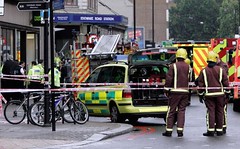
By Vinny Del Giudice
London Fire Journal
London Fire Journal
London's firefighters had been planning and practicing for the worst since the Sept. 11, 2001 attacks on the World Trade Center in Manhattan and the Pentagon in Arlington County, Virginia.
The bells went down starting at about 9 a.m. on July 7, 2005 for bombings on the London Underground and one of the city's famed red ``double-deck'' buses. The brigade's ``blue watch'' was coming on duty.
The London Fire Brigade announced the news in a brief statement about 40 minutes later:
London Fire Brigade has been called to reports of explosions at Edgware Road and Aldgate underground stations. Emergency services are at the scene and further information will be given as soon as it becomes available.
Another statement at 10:10 a.m. told of further blasts:
London Fire Brigade has been called to reports of explosions at a number of locations.
Very early reports had suggested that the explosions were caused by a power surge on the rail system. But after the bus blast, it became clear that that London had suffered its worst bombing since World War II with many dead and injured.
At 12:30 p.m., the fire brigade reported:
London Fire Brigade has been called to reports of explosions at Aldgate, Edgware Road and King's Cross London Transport Stations and Tavistock Square this morning.
Fire cover for the rest of London is being maintained but we would ask the public to only call us for confirmed fires or life threatening incidents.
The bells went down starting at about 9 a.m. on July 7, 2005 for bombings on the London Underground and one of the city's famed red ``double-deck'' buses. The brigade's ``blue watch'' was coming on duty.
The London Fire Brigade announced the news in a brief statement about 40 minutes later:
London Fire Brigade has been called to reports of explosions at Edgware Road and Aldgate underground stations. Emergency services are at the scene and further information will be given as soon as it becomes available.
Another statement at 10:10 a.m. told of further blasts:
London Fire Brigade has been called to reports of explosions at a number of locations.
Very early reports had suggested that the explosions were caused by a power surge on the rail system. But after the bus blast, it became clear that that London had suffered its worst bombing since World War II with many dead and injured.
At 12:30 p.m., the fire brigade reported:
London Fire Brigade has been called to reports of explosions at Aldgate, Edgware Road and King's Cross London Transport Stations and Tavistock Square this morning.
Fire cover for the rest of London is being maintained but we would ask the public to only call us for confirmed fires or life threatening incidents.
The death toll, as of July 18, was 56, including the four bombers.
The London Ambulance Service said its crews ``treated approximately 45 people for critical and serious injuries, and a further 350 for minor injuries. Many other patients will have made their own way to hospital for treatment.'' The fire brigade said: ``Several of our new specialist fire rescue units were deployed to work with the other emergency services to evacuate casualties.''
Crime investigation
The July 7 attacks occurred between the Aldgate and Liverpool Street ``tube'' stations , between the King's Cross and Russell Square stations, at the Edgware Road station and on the No. 30 bus at Tavistock Square, according to the BBC. All the sites are located near the financial district, known as ``The City.''
Closed circuit television recordings revealed four suspects arrived by train at the King's Cross Station before fanning out into the transit system. The New York Times said: ``The bombers began their murderous journey from the northern city of Leeds.''
The bombers were identified as Shehzad Tanweer, 22, linked to the Aldgate blast; Mohammad Sidique Khan, 30, linked to the Edgware Road blast site; Hasib Mir Hussain, 18, linked to the bus attack; Germaine Lindsay, linked to the King's Cross attack. Tanweer, Khan and Hussain were born in the United Kingdom. Lindsay was born in Jamaica.
A police source told the Daily Mirror newspaper: "They are dressed in casual clothes with big rucksacks on their backs and look for all the world like four men off on a backpacking holiday, instead of four mass murderers on the last leg of their deadly mission."
Fire response
About 200 London firefighters responded to the bombings.
``Twelve fire appliances with 60 firefighters attended the incident at Edgware Road, twelve fire appliances with 60 firefighters attended the incident at King's Cross, ten fire appliances with 50 firefighters attended the Aldgate incident and four fire appliances with 20 firefighters were called to Tavistock Square,'' the fire brigade reported on its web site.
The web site of the Poplar Fire Station - F22 - said:
Crews from Poplar were involved in the Rescue Operation at the Train Blast at Aldgate Station. Our thoughts and Prayers at this time are with the victims of this Outrage. London is a City with a Rich and Powerful History, we will never cave in to the faceless cowards who try to destroy our way of life.
By most accounts, the fire brigade's response went according to plan.
Prime Minister Tony Blair applauded the emergency response in Parliament on July 13.
London Fire Brigade Commissioner Ken Knight praised his troops.
"Firefighters, control staff and support staff were all magnificent in the aftermath of the bombings, as the people of London would expect,'' Knight said. ``I am sure their professional response made a crucial difference to the people who were injured or trapped."
And yet, as in any incident, there were lessons to be learned.
Radio communications on July 7 presented a problem for firefighters, much like at the World Trade Center and the Pentagon on Sept. 11, 2001 The fire brigade's 70 Megahertz two-radio system has very limited range below ground, and commercial cell phone networks were overloaded.
The Fire Brigades Union - which had staged a series of strikes over a fire brigade modernization plan - expressed concern about fire brigade staffing. ``We were very seriously stretched by these awful attacks,'' Andy Dark, regional secretary of the union, said in a press release. He cited the closure of the Manchester Square fire station in central London and the redeployment of 10 engines from central London stations to the suburbs.
`Amazing sense of courage'
Parish priest Nicholas Wheeler, who ministered to the injured - as well as the rescuers - at King's Cross, praised the first responders. ``Many of the firemen and police were very young, and it was their first experience with something so horrific," said Wheeler, quoted by The New York Times. "They went down with an amazing sense of courage and came up having seen things you would not wish anyone to see."
Newspaper photos showed bystanders pitched in to help the walking wounded, with one photo becoming ``one of the defining images of last week's atrocity, encapsulating the horror and the heroism of a city plunged into terror,'' according to The Observer newspaper.
The Observer continued:
Ex-fireman, 28-year-old Paul Dadge, clearly frightened but determined to help, holding on to a bloodied and barefoot woman, her burnt face covered with a large white mask, her hair singed.
Haunted by his contact with the distraught young woman, Dadge returned to King's Cross on Friday to search for her, but to no avail. 'I just wanted to find her and see if she was OK,' he said. 'If she had been here I would have said: "You were so brave".'
(On July 9) his search ended in relief when the young woman, known only as Davinia, was tracked to a London burns unit where she was said to be in a serious but stable condition.
Mr Dadge had spotted Davinia standing alone on a street corner after she escaped the blast. 'She was really brave,' he said. 'A lot of people were complaining about their burns, but she didn't.
The attacks lent momentum to a safety campaign launched in May encouraging British commuters to store emergency contacts, such as next of kin, on their cell phones. British paramedic Bob Brotchie is credited with starting the ICE - "In Case of Emergency" - program to help first responders identify victims of accidents and disasters.
``Users are being urged to enter a number in their phone's memory under the heading ICE - In Case of Emergency,'' the BBC reported. ``Paramedics or police would then be able to use it to contact a relative.''
`Hell on earth'
Relief fire crews provided assistance for the intensive police investigation in the days following the blasts, including the recovery of bodies in the Piccadilly Line tunnel between Russell Square and King's Cross - scene of the worst carnage. The Mirror newspaper reported that ``firemen with experience of `burn patterns' established the bomb was on the floor by the doors in the first carriage'' at that deadly blast.
Of the survivors,``Many of the most severely injured people either walked or had to be carried half a mile along the tracks to Russell Square station. King’s Cross station was much closer but they could not get back past the wreckage,'' The Times newspaper reported.
Rescue workers toiled ``alongside forensic experts from Scotland Yard ... desperately hunting for clues about the type of explosives used in the bombs and the identity of the bombers,'' according to The Independent newspaper.
The BBC reported:
Emergency teams are dealing with horrific scenes as they recover bodies from the mangled wreckage of a Tube train near King's Cross station.
Teams face intense heat of up to 60C (about 140F), fumes, vermin, asbestos and initially concern the tunnel might collapse.
"I can't say what it's like or explain it, but it's carnage,'' said firefighter Arrol Thomas.
Recovery teams are working in dangerous and cramped conditions 70ft (21.3m) underground in a three-and-a-half metre wide tunnel only a little larger than the train itself.
BBC correspondent Mark Simpson, at King's Cross station, described the operation below ground as "a gruesome task".
Initial fears the tunnel might be in danger of collapsing have now passed but conditions below ground remained "atrocious" he said.
He said: "One rescue worker described it as 'hell on earth'."
Battle tested
London is no stranger to war and terror, having been target of Irish Republican Army bombings, the German ``blitz'' and rocket attacks of World War II and Zeppelin raids in World War I. The city has also had its share of rail accidents and other emergencies.
"London, sadly, has come through a series of events, whether they be terrorist attacks or genuine accidents, which have meant we have been able to refine and refine again the procedures," Malcolm Kelly, an assistant fire commissioner, told the BBC. Kelly served as incident commander at the Edgware Road station on July 7.
Today's London Fire Brigade provides fire and rescue services from more than 100 stations across the city. Emergency medical services are provided by a separate agency, the London Ambulance Service.
The fire brigade's typical response to alarms - British firefighters call them ``Shouts'' - in densely populated area of the city would be two fire engines within five minutes and a third engine within eight minutes.
Each ``appliance'' is typically staffed by four or five firefighters. The station officer on the first arriving engine typically assumes incident command. Mundane calls are the rule.``In London, more than a third of accidental fires in the home start in the kitchen – and nearly all involve the cooker,'' according to the fire brigade.
London's brigade also fields special units, including fire rescue units, turntable ladders, aerial platforms and a mobile command post.
Just this year, the number of fire rescue units was doubled to 10. The heavy-duty vehicles are placed stragetically around London to ensure that, on average, they can reach an incident within 15 minutes, according to the fire brigade's web site. One of the rescues is located at the Euston fire station, just down the road from King's Cross.
``Specialist crews on the new rescue units will be trained and equipped to handle complex rescues, including rescues from road and rail accidents, water, mud and ice, urban search and rescue incidents (such as collapsed buildings), chemical spills and for difficult rescues involving the use of ropes and lines,'' the brigade said.
Training is paramount. On Sept. 7, 2003, for example, the fire brigade and other emergency services staged a large-scale exercise at the Bank tube station in the old City of London. The scenario was for a chemical attack with mass casualties. The Bank station is located close to the scene of the July 7 attacks.
The London Underground, itself, traces its history to 1863 when the world's first subway opened in London, according to the Transport for London web site. Today, London Underground serves 275 stations and carries an average of more than 3 million ``passenger journeys'' a day. At peak hours, as many as 500 trains are operating over the 253-mile (408 kilometer) system.
London Mayor Ken Livingstone commended the city's emergency services for their preparation and response to the July 7 attacks, saying:
Following the al-Qaeda attacks on September 11th in America we conducted a series of exercises in London in order to be prepared for just such an attack. One of the exercises undertaken by the government, my office and the emergency and security services was based on the possibility of multiple explosions on the transport system during the Friday rush hour. The plan that came out of that exercise is being executed today, with remarkable efficiency and courage, and I praise those staff who are involved.
Firefighter's account
The web site for the Guardian and Observer newspapers published the eyewitness account of Terence Adams, a divisional commander in the London Fire Brigade, at King's Cross station. Adams climbed down into the tunnel to help bring out the casualties.
Said Adams:
'The effect of a blast is like a thunder clap or a very loud firework and that can numb your thoughts for a while. We knew that the difficulty we were going to have was managing people and getting them to the surface.
Getting people out of the train was difficult, it was a matter of getting them out by hand or torchlight but it was difficult to even see them: there wasn't smoke as such but a very, very fine dust which really reduced visibility.'
It was pretty chaotic at first, as you would expect. There were blast injuries and a lot of people were traumatised.
'Paramedics and Network Rail staff were helping people and providing first aid. The hundreds of people who were pouring out of the tube were in obvious shock and looked completely confused.
I'm trying not to dwell on the trauma of the events, though: this is our role and I accept that that's what we're there for.'
Survivor's account
A woman identified only as Rachel from North London provided the BBC with her account of the disaster on the Picadilly Line train between King's Cross and Russell Square. She was in the first car of the train - where the bomb was detonated, killing about two dozen of her fellow passengers. Rachel boarded the train prior to King's Cross.
Her story:
I was in the first carriage, behind the driver's carriage, standing by the doors - it was absolutely packed.
Even more people got on at Kings Cross. It felt like the most crowded train ever.
Then, as we left Kings Cross, at about 8.55am, there was an almighty bang. Everything went totally black and clouds of choking smoke filled the Tube carriage and I thought I had been blinded. It was so dark that nobody could see anything.
I thought I was about to die, or was dead. I was choking from the smoke and felt like I was drowning.
Air started to flood in through the smashed glass and the emergency lighting helped us see a bit. We were OK.
A terrible screaming followed the initial silence.
We tried to stop ourselves from panicking by talking to each other and listening to the driver who started talking to us.
There was screaming and groaning but we calmed each other and tried to listen to the driver.
He told us he was going to take the train forward a little so he could get us out, after he had made sure the track wasn't live.
We all passed the message into the darkness behind us, down the train.
After about 20 to 30 minutes we started to leave the train.
We were choking and trying not to panic because we knew that would mean curtains.
We tried to keep each other calm, I remember saying: "If anyone's boss gives them grief for being late, we know what to say to them, eh, girls?"
`Pray they died quickly'
The Telegraph newspaper reported that the fire brigade, ambulance service and the police ``faced horrendous physical, psychological and logistical difficulties'' and that the ``grim nature of the work took its toll.''
The report also said:
Some workers were given counselling because they were unable to cope with the scenes that confronted them.
"It was like the Towering Inferno down there," one experienced rescuer said. "I've seen some shocking things but nothing as bad as this.
"There were people with limbs missing and their organs spilling out. We can only pray that they died quickly.
"The heat was almost unbearable. It was dark and dusty but we are doing everything we can to make sure no clues are lost."
The rescue effort was also hampered by the presence of rats scurrying over the wreckage and gnawing at the victims' decomposing bodies. "It was pretty disgusting," said one rescuer. "The terrible smell was making us gag."
The tunnel on that stretch of the Piccadilly Line is barely wider than the train, so the workers were unable to go along the side of - or even on top of - the train and instead had to cut through the coaches.
Moorgate - 1975
The recovery effort at Russell Square recalled an underground disaster three decades earlier, when a Northern Line train careened past the Moorgate station and into a dead end tunnel on Feb. 28,1975.
According to veteran London firefighter Neil Wallington's book ``Great Fires of London:"
Forty-two passengers were killed but many more were trapped in the crumpled carriages inside the tunnel. The last live casualty was released after some twelve hours, but the recovery of the bodies took a further five days and nights and involved 1,000 workers firefighters working in short shifts because of the heat and fetid condition deep into the tunnel.
London firefighters wriggled past the real carriages to get the casualties and ``rescue teams were forced to wear breathing apparatus because of deteriorating air quality,'' Wallington wrote.
Gerard Kemp of the Daily Telegraph, the only journalist allowed to visit the site, reported:
"It was a horrible mess of limbs and mangled iron."
"One of the great problems (for the fire brigade) was the intense heat down there. It must have been 120 degrees. It was like opening the door of an oven."
The cause of the Moorgate disaster remains a mystery.
Kings Cross - 1987
Disaster also visited the Kings Cross station on Nov. 18, 1987 when a flash fire engulfed an old wooden escalator serving the Picadilly Line. About 30 people perished in that disaster including a rescuer, Colin Townsley, station officer from the Soho Fire Station in central London.
According to the BBC:
The blaze reportedly began at about 1930 GMT in a machine room under a wooden escalator.
The fire started as the evening rush hour was trailing off but hundreds of commuters were still in the station which is London's busiest.
Many passengers were trapped underground as the escalator went up in flames.
More than 150 firefighters wearing breathing apparatus tackled the blaze and searched for survivors.
But they were not able to bring the main fire under control until approximately 2150 GMT.
Wartime tragedies
Tragedy also visited the London Underground during World War II, when the stations were used as air raid shelters.
At the Trafalgar Square station on Oct. 12, 1940, seven people were killed when a German bomb ``penetrated the surface and exploded at the top of the escalator causing an avalanche of wet earth to descend onto the platforms,'' according to Antony Clayton's book ``Subterranean City - Beneath the streets of London.''
Clayton also wrote:
Much more serious was the incident on 14 October at Balham, where six hundred were sheltering. Following a direct hit on the street above, the roadway collapsed and masses of ballast and earth slid into the tunnel, whilst the flood from the shattered mains carried all before it. From the resulting pile of sludge 68 bodies were eventually recovered.
On 11 January 1941 at Bank station 56 people were killed after a bomb plunged into th station concourse, exploding in the escalator machine room and damaging trains at the platform below.
The greatest loss of life at a wartime tube station occurred at Bethel Green on March 3, 1943, when 173 people suffocated during an alert.
``People poured into the station down a poorly lit staircase,'' Clayton wrote. ``After a woman with a child tripped and fell at the foot of this staircase panic ensued, with more people falling and being crushed by the relentless push from those behind.''
July 21
London firefighters responded to four blasts on the city's transit system - two weeks after the deadly July 7, 2005 attacks. The BBC reported "four minor explosions'' - three on London underground and the fourth on a double-deck bus. Police reported one injury.
``We have seen it happen before,'' Sir Ian Blair, commissioner of the Metropolitan Police, said of the July 21 incidents. "The emergency services are getting control over a very confused scene. Clearly this is a very serious incident."
According to the London Fire Brigade web site:
Over 60 firefighters and 12 fire engines have been called to incidents at Shepherds Bush, Warren Street, Oval London underground stations and Shoreditch High Street. As a precaution officers have been deployed at Warren Street London Underground Station in full protective equipment in order to carry out an examination of the scene. The police have carried out an initial examination at Oval and early indications show that there is no trace of chemical agents.
London Mayor Ken Livingstone sought to reassure citizens, saying: "This is a diffficult time for all Londoners and our first priorities will be to provide all possible help to the police investigation, remain calm and refuse to allow the terrorists to stop us from going about our business and enjoy everything this city has to offer.''
London Underground log for July 7
The BBC published a London Underground log from July 7, 2005:
0850: First indications received by London Underground's Network Control Centre (NCC) of a problem on the network suggested a power supply problem affecting a large area as stations were reporting that some escalators had stopped and other station equipment was no longer working.
The NCC immediately treated this as a power supply issue and took actions to resolve the issue.
At this stage NCC believed that the problem could be resolved and power would be restored by 09:15. What we now know is that the power surge occurred as a direct result of explosions knocking the power supply out at the three incident sites.
08:51: The Central Line called the NCC enquiring about a possible large noise or explosion onboard a train at Liverpool Street.
0851: The first call to the Metropolitan Police indicating that they were being asked to attend a person under a train incident caused by the derailment.
08:52: The Metropolitan Line confirmed that an explosion had taken place. NCC believed this to be directly related to the ongoing power supply issue. Loud noises or explosions often accompany a power supply rupture.
08:53: London Underground commenced Gold Control (command and control person in charge of a serious incident on the Underground). On its own a power surge is a major issue.
0859: The NCC receives a report indicating that a train departing Edgware Road station had hit the tunnel wall. Further information came in quickly, including smoke and passengers self de-training and walking down the tunnel towards the nearest station, Edgware Road. Sub-surface line managers immediately called the emergency services believing this to be a derailment. At this time, LU believed it was dealing with a major incident (derailment) and a serious power supply issue on the network.
09:01: The Metropolitan line reported that a person may be under a train at Liverpool Street. This was the third issue that the Network Control Centre was now dealing with within a space of eleven minutes.
09:03: The Piccadilly line Duty Operations Manager receives reports of passengers running from King's Cross.
09:05: The NCC is advised of walking wounded at Edgware Road.
09:09: An engineer reports losing a high tension power cable between Mansell Street and Moorgate.
09:10: The Piccadilly line Duty Operations Manager reports to NCC a request for ambulances. In the twenty minutes that had passed since.
09:11: The Piccadilly line Duty Operations Manager reports loss of traction current in Russell Square both east and westbound and that a loud bang had been heard at Russell Square westbound with staff already investigating.
0915: It was clear that the series of events occurring across the network were directly related to multiple explosions and a Code Amber alert was declared which means trains are brought into stations and told to stay there until further notice.
This was LU commencing the shutdown of the entire Tube network as it was evident that the continued operation of the Tube presented a risk to customers if further explosions occurred. LU staff began de-training large numbers of passengers and evacuating them from the network.
0917: Metropolitan Police received a call specifically stating than an explosion had occurred at Edgware Road. This explains the Metropolitan Police reporting that the Edgware Road explosion occurred at 0917.
0917: Metropolitan Police received a call specifically stating than an explosion had occurred at Edgware Road. This explains the Metropolitan Police reporting that the Edgware Road explosion occurred at 0917.
Newspaper timeline for July 7
The Independent newspaper recounted the events of July 7, 2005:
8.50 a.m.: Three bombs explode within a minute on London Underground trains.
8.51: Police get their first call to the Aldgate explosion.
9.15: All trains are stopped by London Underground. Press Association reports emergency services have been called to an explosion at Liverpool Street.
9.17: Police get first call about Edgware Road. All Tube stations are evacuated.
9.33: London Underground says there has been "another incident at Edgware Road" station.
9.40: British Transport Police say five "power surge incidents" - some causing explosions - have occurred on the Underground.
9.47: Thirteen people die when an explosion tears through the back of the no 30 bus.
10.02: Scotland Yard says its officers are assisting with a "major incident".
10.10: It is confirmed that Tony Blair at the G8 Summit in Gleneagles is being updated on events.
10:28: London Fire Brigade says it has been called to four "explosions".
10:39: All London hospitals are put on major incident alert.
11:00: Members of the public are told not travel to London.
11:16: Metropolitan Police Commissioner Sir Ian Blair says there have been at least six explosions, but claims the picture is still "very confused".
11.52: All London hospitals are full, police confirm.
12 noon: Tony Blair addresses the nation and says an unknown number of people have died in a series of "barbaric" terrorist attacks.
Fire Brigades Union
Matt Wrack, general secretary of the Fire Brigades Union, sent the following ``circular'' to members regarding July 7:
I am sure that all members will join me in condemning the horrific bombings in London last week. This was a terrible and horrific attack on ordinary Londoners going about their daily lives. The thoughts of all FBU members will have been with the victims, their families and friends. I know that you will wish to pay tribute to the passers-by who assisted at the scene, helping to save lives and prevent further suffering. We pay tribute also to the transport workers who responded at the various incidents to attempt to protect their passengers as far as possible from further injury and death.
Emergency Service workers performed as we would expect them to – with professionalism, dedication and compassion. Ambulance staff and hospital workers put their training and procedures into practice to magnificent effect. Our thanks go to all of them. At the heart of the emergency operation were our own members in the London Fire Brigade. They played their part with the professionalism and humanity that lies at the heart of our Service. I know that many messages have been received in London from members throughout the country, demonstrating the pride we all feel when we see fellow members of the Service performing well.
Sadly however, the Fire Service in London – as elsewhere – has been under attack. The London Fire Authority itself has agreed cuts in central London stations. One fire station has closed and the Authority proposes further job cuts later this year. There is a similar picture elsewhere in the UK. It is not sufficient for politicians to praise our members for a job well done. We have the right to the best equipment, training and resources. We also have the right to insist that these cuts are stopped immediately. I shall be discussing with London politicians our call for an urgent review of the cuts proposed in London.
On a final note, I would like to urge all members to join me in opposing any attempt to use the tragic events of 7th July as a means to create divisions in our society. An attack on civilians in London is an attack on a multi-ethnic community. Indeed, London is the most multi-racial city in Europe. It is truly appalling therefore that the response of some has been to launch attacks on ethnic minorities, on muslim communities and on mosques. The far right is attempting to use these terrible events to stoke up division and racial hatred. Trade unions are built on the principle of unity. It is a powerful principle which in our case reflects the humanitarian nature of our job. I am sure that FBU members will stand with other workers for unity and in opposition to those who would attempt to divide us.
Bells never stop ...
On July 9, 2005, an ``eight-pump'' fire swept London's Hard Rock Cafe - even as the fire brigade continued to operate at the scene of the July 7 bombings. Guitars played by the Beatles, the Rolling Stones and the Who were rescued from the fire.
A statement on the London Fire Brigade web site said:
"Eight fire engines and around forty firefighters tackled a blaze in a restaurant in Piccadilly. Around sixty people were evacuated from the restaurant after smoke was seen coming from the roof of the building. The fire started in the extraction ducting leading up the side of the seven storey building. Around a quarter of the ground floor restaurant was destroyed by the blaze which fire investigation officers believe started accidentally."
On July 14, 2005, precisely a week after the terrorist bombings, the London Fire Brigade battled one of the city's largest fires in many years - a ``30 pump fire'' at a DVD and CD factory in Wembley in North London. Two hundred factory employees escaped before firefighters arrived - and construction workers were evacuated from the building site of a sports stadium.
Flames destroyed half of the two-story factory as well as 30 vehicles, the fire brigade said, and sent plumes of dark black smoke over the city. Three Valleys Water, the local water utility, estimated the fire brigade used ``17 million litres of water,'' reducing the water pressure in parts of North London, the BBC said.
Subscribe to:
Posts (Atom)