Fire Buffs promote the general welfare of the fire and rescue service and protect its heritage and history. Famous Fire Buffs through the years include Edward VII, who maintained a kit at a London fire station.

September 20, 2017

LIVERPOOL LEWIS'S

Photo: Merseyside Police/Liverpool City Police
1941 Blitz

1886 Fire

"David Lewis founded a small shop selling men’s and boy’s clothing in 1856. The sale of women’s clothes began in 1864, and by the 1870s Lewis’s Department Store was in full swing," according to the Historic Liverpool website. "The building burnt down in the infamous fire of 1886, and suffered bombing at the hands of the Luftwaffe during the Second World War. Nevertheless, it was rebuilt each time."

September 19, 2017

MAIDA VALE - 1997

Photo: Instagram
London Fire Brigade aerial platform, Maida Vale, 1997

SHEEPCOTE ROAD - 1995

Photo: Instagram
London firefighters at Sheepcote Road, Harrow, August 1995
 

July 25, 2017

GRENFELL TOWER - 2017


Photos: Metro, BBC, London Fire Brigade

By BBC Newsnight
July 7, 2017


A series of failings that hampered the efforts of firefighters to tackle the Grenfell Tower fire and rescue the building's residents have been identified by a BBC investigation.

Crews cited low water pressure, radio problems and equipment that was either lacking or did not arrive before the fire on 14 June got out of control.


Newsnight has learned a high ladder did not arrive for more than 30 minutes.


The London Fire Brigade says it has changed its procedures since the fire.


A high ladder will now automatically be sent to a fire in a tower.

An independent fire expert said having the high ladder, which is also known as an "aerial", available earlier would have given firefighters a better chance of stopping the blaze when it jumped from a fourth floor flat in the tower block and began to race up the side of the building.


More than 200 firefighters and 40 fire engines were involved in battling the blaze that engulfed the block in North Kensington, west London.


About 300 people are believed to have lived in Grenfell Tower and most got out on their own.


The fire brigade rescued 65 people but at least 80 people are thought to have died.


An independent fire expert said having the high ladder, which is also known as an "aerial", available earlier would have given firefighters a better chance of stopping the blaze when it jumped from a fourth floor flat in the tower block and began to race up the side of the building.


More than 200 firefighters and 40 fire engines were involved in battling the blaze that engulfed the block in North Kensington, west London.


About 300 people are believed to have lived in Grenfell Tower and most got out on their own.


The fire brigade rescued 65 people but at least 80 people are thought to have died.

Matt Wrack, general secretary of the Fire Brigades Union, said: "I have spoken to aerial appliance operators in London... who attended that incident, who think that having that on the first attendance might have made a difference, because it allows you to operate a very powerful water tower from outside the building onto the building."


A London Fire Brigade (LFB) spokesman confirmed the so-called "pre-determined attendance" for a tower fire - the list of appliances which are automatically dispatched - has been changed from four engines to five engines plus an aerial.


The spokesman said: "An 'interim' change to pre-determined attendance for high rise buildings was introduced in direct response to the government's action to address concerns of cladding on buildings.


"The Brigade's pre-determined attendance to high rise buildings had already been increased in June 2015 from three fire engines to four as part of our ongoing review of high rise firefighting.

"It is important to understand that fires in high rise buildings are nearly always dealt with internally, not usually needing an aerial appliance.


"The fundamental issue of high rise safety remains that buildings are maintained to stop fires spreading."


The spokesman added: "The Brigade has a fleet of specialist aerial firefighting appliances and these attend a variety of incidents across the capital."

Newsnight's investigation also heard that firefighters had struggled with water pressure problems and the fire service had to call Thames Water to ask the company to increase pressure in the area.


One firefighter said: "The fire floors we went in were helmet-meltingly hot… when we were clearing flats, it was a case of a quick look and closing doors because the water pressure wasn't up to firefighting."

A Thames Water spokesman said:


 "We've been supporting the emergency services' response in every way possible… any suggestion there was low pressure or that Thames Water did not supply enough water to fire services during this appalling tragedy is categorically false."


Firefighters also described problems with radio reception inside the building and said they lacked enough of the "extended duration" breathing apparatus they needed, especially when reaching the higher floors of the building.


All fire engines have basic breathing apparatus that provides firefighters with oxygen for around 30 minutes.


The extended duration apparatus enables them to breathe for a theoretical 45 minutes - but working in dense smoke and intense heat 20 storeys up uses up the compressed air in the equipment more quickly.


The LFB said all of its rescue units carry extended duration apparatus and "all of the fire brigade's rescue units attended the incident".

The LFB said the police investigation into the fire would examine the brigade's response "including all of the issues Newsnight has raised".


Questions have also been raised about why a 42m firefighting platform had to be called in from Surrey to fight the fire at Grenfell - itself 67m high - because the LFB does not have one of its own.


The LFB spokesman said it had never responded to a fire on the scale of Grenfell Tower before.

He said: "The commissioner has made clear her intention to fully review the brigade's resources and seek funding for any additional requirements."

January 13, 2017

RIPLEY - 1969


On Feb. 10, 1969, a fire and explosion at a hardware rocked the village of Ripley in Surrey. The Guilford Times and Advertiser said: "The fire began while a tanker was pumping paraffin into the store; a store which sold everything from bicycles, television sets and crockery to furniture, paraffin, gas and petrol." Firefighters responded from Guildford, Woking, Esher and Camberley.

January 12, 2017

SOUTHEND AIRPORT - 1960

Photo: londonreconnections.com

On Oct. 9, 1960, a Handley Page Hermes aircraft operated by 
UK-charter carrier Falcon Airways overshot the runway while landing at London's Southend Airport and tilted to a stop along a railway line on its front end, Wikipedia said. Five people were injured. The government shut down the airline due to safety concerns in 1961.

EALING - 1973

Photo: Cultural Community Solutions
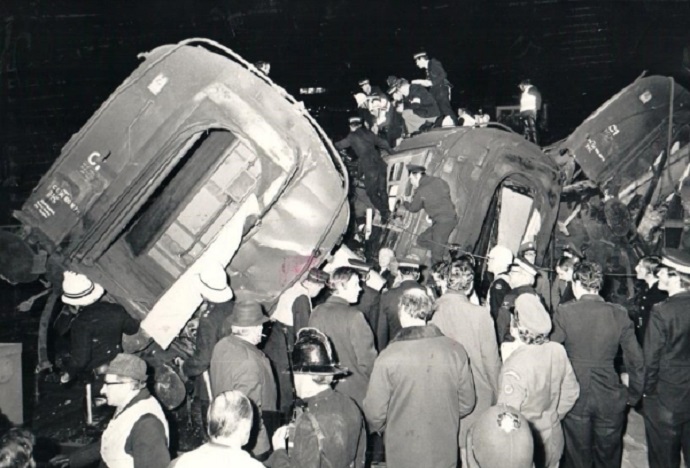
On Dec. 19, 1973, an express train traveling at 70 mph derailed at Ealing in West London, killing 10 people and injuring almost 100 more. Investigators determined the accident was caused by an open door on the locomotive's battery box.
 

January 11, 2017

SUTTON COLDFIELD - 1955

Photo: Birmingham Mail

On Jan. 23, 1955, an express train plowed into the platform at Sutton Coldfield station in Birmingham, killing 17 people and injuring 25 others.


"The first carriage was crushed between the engine and the second carriage," The Birmingham Mail recalled on the 60th anniversary. "Another was knocked into the air, causing it to drag along the station roof."

The train from York to Bristol was traveling at twice the speed limit, the BBC said.

It had been diverted from its normal route.

QUEEN VICTORIA ST. - 1902


On June 9, 1902, fire claimed nine lives on Queen Victoria Street in the City of London. Escape ladders were too short to rescue people from the top floors, prompting pubic outrage.

The Spectator reported:

A great and fatal fire took place at a warehouse in Queen Victoria Street in broad daylight on Monday evening.

The building, which is close to the Mansion House Station of the District Railway and only three hundred yards from the chief City fire-station, is used as workshops, offices, and stores by the General Electric Lighting Company.

When the alarm was given at five o'clock a number of girls were at work on the fourth floor, which the Watling Street fire-escape proved too short to reach.

Many of the girls leaped into a tarpaulin held out in the street, but when the fire had been got under and the fourth floor entered the bodies of eight girls and one boy were found in the ruins.

The firemen appear to have worked with the utmost gallantry, and in particular two women were rescued by splendid efforts on the part of the men of the Salvage Corps.

But the fact that the longest fire- escape available at the chief City fire-station was unable to reach the fourth floor of a London warehouse has created a very painful impression.

We do not wish to make any criticism in regard to individuals till after the inquest, but it is clear that the life-saving apparatus available at short notice in the City, with its lofty buildings, is at present by no means adequate, and must be made so without delay, —if, indeed, the whole Fire Brigade does not require reorganization.

SOHO STATION - 1940

Photo: London Fire Brigade
On the evening of Oct. 7, 1940, Soho fire station in central London took a direct hit during the Blitz, killing Station Officer William Wilson and Auxiliary Firefighter Frederick Mitchell as well as two passersby. The station's fire apparatus sustained damage.

November 09, 2016

CROYDON - 2016


On Nov. 9, 2016, a tram derailed near Addiscombe Road in Croydon, killing five people and injuring more than 50 others. The London Fire Brigade sent eight engines and five fire rescue units.  London Fire Commissioner Ron Dobson said: "Firefighters worked tirelessly this morning to help the injured and rescue those who were trapped.”

September 23, 2016

REUNION - 1956


Photo
: London Fire Brigade

London firefighters rescue Dennis Norman McGowan, 19 months old, on Feb. 25, 1956. The child's mother waits below.

MANCHESTER - 1996


Photos: Wikipedia, Manchester Fire & Rescue

On June, 15, 1996, the Provisional Irish Republican Army detonated a 3,000-pound bomb on Corporation Street in central Manchester, injuring more than 200 people during the Euro football championships.

Remarkably, there were no deaths.

The bomb was the largest denotation in Great Britain since World War II.

A telephoned warning preceded the blast by about 90 minutes allowing for the evacuation of 75,000 or more people.

SURREY DOCKS - 1940


Photo: PortCitiesLondon, Caters News Agency
Fire at Surrey Commercial Docks, Rotherhithe on  Sept. 7, 1940, the first day of the Blitz. 
Gerry Knight, a station officer, sent a message to the alarm office from the docks, saying: "Send all the bloody pumps you've got … The whole bloody world's on fire!" according to PortCitiesLondon.

September 12, 2016

TAUNTON - 1978


Photos: BBC

On July 6, 1978, fire burned out a British Rail sleeping car at Fairwater Close, Taunton, killing 13 people and injuring others.

The train was travelling from Penzance to Paddington station in London when 
laundry stacked against an electric heater ignited, the BBC said.

All 31 of the dead or injured were in the front two carriages.

Car doors were locked, a violation of British Rail rules, preventing a means of escape.

A passenger said: "I remember being woken up and being carried out of the train. The place was full of smoke. All I could see was people smashing the windows and trying to get other people out."

Fireman Derek James said: "It was a really eerie scene. Then we had instructions to go in and remove the people from the carriage. It was horrendous in there."

Ray Stokes, a newspaper reporter, said people living near the tracks used wire cutters to break down a fence to render aid.

December 28, 2015

SECOND GREAT FIRE - 1940

On the night of Dec. 29-30, 1940, London suffered the "Second Great Fire" - timed by German raiders to coincide with low tide on the River Thames and run the fire brigade's water supply dry

Fourteen 
firefighters died and 250 were injured in the destruction that stretched south from Islington to St Paul's Cathedral, scorching an area greater than that of the Great Fire of London of 1666.

Nazi bombers dropped more than 24,000 high explosives and 100,000 incendiaries, leveling historic buildings and gutting the medieval Great Hall of the City's Guildhall

The firestorm destroyed 19 churches, 31 guild halls and ravaged Paternoster Row, 
center of the London publishing trade where an estimated 5 million books were lost in the flames.

As the flames approached St Paul's Cathedral, a symbol of London's glory, 
Prime Minister Winston Churchill called of the Fire Brigade and St. Paul's fire watch to save the landmark - and they did.

 
The famous photograph "St Paul's Survives" (above) was snapped from the roof of the Daily Mail by Herbert Mason.

August 31, 2015

HUDDERSFIELD - 1941


Photos: ITV, Examiner

On Oct. 31, 1941, fire swept H. Booth & Son clothing factory in Huddersfield, England, claiming 49 lives. 
Recalling the fire, The Huddersfield Daily Examiner said:  "The five-story clothing factory had only one staircase, no evacuation drill and a buzzer system which failed." The cause was deemed to be "a smoker’s pipe left alight inside a raincoat pocket," Wikipedia said.

August 04, 2015

COVENT GARDEN - 1949


On Dec. 21, 1949, fire broke out in stacks of Christmas trees stored in catacombs beneath London's Covent Garden flower market, killing a fireman. Armed with pneumatic drills, the fire brigade bored holes in concrete floors to release smoke. 
More than 1 million gallons of water were pumped into the catacombs and rose as high as as five feet.

GREEN GODDESS

Illustration: BBC


From 1953 to 2004, the British government maintained a fleet of "Green Goddess" reserve fire engines for civil defense and national emergencies. Photo above shows military firefighters and "Green Goddess" at fire in Cambridge during 2002 fire strike. The engines were also used during the 1977 fire strike.

July 30, 2015

OAKWOOD HOSPITAL - 1957


Three members of the Kent Fire Brigade died in the aftermath of a fire at a psychiatric hospital in November 1957.

From Kent History Forum


The fire which broke out at Oakwood Mental Hospital on 29th November 1957 will never be forgotten by the Brigade as amongst the six killed at the scene were three Brigade personnel. An emergency call was made by the night Nursing Superintendent immediately he discovered the fire whilst making his rounds.

The call was received at Maidstone Fire Station at 06.40 hours and were on the scene within four minutes. On arrival the Brigade found hospital staff fighting the fire with a jet, direct from a hydrant. Faced with a developing fire situation at first floor level adjacent to the wards containing 350 mentally ill patients, the officer-in-charge of the two appliances and Turntable Ladder despatched in the initial response got to work after "making pumps 6" at 06.48.

Having started in the tailor's shop on the first floor, the fire raged out of control through the workshop wing, the printer's shop, the library, a staff rest room, the TV room and upwards into the roof. The fire was brought under control by six jets and the "Stop" message was sent at 07.30.

Adjacent to the section of the building where the fire had occurred was a brick built ventilation tower 115 ft in height.

Whilst the cleaning up operations were in progress and half the personnel were enjoying a well earned cup of tea, at 10.01 without any warning, the tower collapsed completely falling on the workshop block and causing the destruction of the building around it. Buried beneath the tons of masonry were several members of the Brigade and also some Oakwood staff including the hospitals Chief fireman. Others were trapped on all levels of the building from the basement to the first floor, some being in considerable danger.

The rescue operations commenced without delay and were organised by Brigade Control with firemen and hospital staff and a request was made for the  attendance of Civil Defence Rescue Parties who responded within a very short time from six towns and who were very quickly at work.

Working in extremely dangerous conditions, under large quantities of bricks and rubble and soaking wet, fire weakened timbers, the rescuers struggled through the remains of the workshops wing to rescue those who had been injured.

Recovered form the wreckage were the three bodies of the firemen who had been killed. Retained Station Officer SE Pearce who had been digging through the rubble searching for casualties found a partially buried body. After further frantic digging through the debris he discovered to his distress that he had uncovered the body of his own brother, ADO Leslie Pearce. He collapsed from shock and was taken to hospital by ambulance. Search and Rescue operations continued until the last body, that of a civilian, had been recovered at 14.30 hours on Sunday 1st December 1957.

The firemen killed were: 

ADO LA Pearce - C Division, Retained Fireman AE Farrow - Loose Fire Station and Retained Fireman JA Hawkes -Loose Fire Station.

The firemen injured were:

ADO HR Evans-Brigade Headquarters, Retained Station Officer SE Pearce Maidstone Fire Station -Retained Fireman DS Latham - Loose Fire Station, Retained Fireman GR Burden -Loose Fire Station, Retained Fireman NF Austin - West Malling Fire Station, Retained Fireman C Wallis - Maidstone Fire Station.

Before the funeral service for the three Kent Firemen on December 5th, large crowds gathered in Maidstone to pay their last respects. The procession was led by Senior Officers and over a hundred firemen from all four Divisions of the County and the funeral service attended by nearly 800 people,  was conducted by Canon FLM Bennett at All Saints Church, Maidstone.

A Tribunal appointed by the South East Metropolitan Regional Hospital Board held a public enquiry into the disaster on the 30th/31st January 1958, finding that a clothes iron, which had been left on overnight in the tailor's shop, had been the cause of the fire. 

Source: Fifty Vigilant Years and CFO's Annual Report 1957/58

July 29, 2015

COMIC RELIEF


Fireman alongside statue of Queen Victoria after fire in Stepney, 1931

July 27, 2015

METROPOLITAN WHARF - 1973

Photo: flashback.com
40 pumps, Metropolitan Wharf, Wapping, May 10, 1973

WELLESLEY - 1914


On March 11, 1914, fire destroyed the training ship Wellesley on the River Tyne at North Shields. The old wooden vessel was moored on the river as an industrial training school for wayward boys. The youngsters battled the flames, assisted by Tyne Commissioners fire boats. The smoke "was yellowy with this tar content in it," Edward Joseph Hatfield, one of the boys, recalled as an adult.

July 24, 2015

COLONIAL WHARF - 1935


On Sept. 25, 1935, fire swept Colonial Wharf in East London. The 60-pump blaze started in a warehouse for rubber, tea and spirits and burned for four days. A news dispatch said: "Blazing debris fell on four barges, destroying them, and streams of molten rubber ran down and blocked the drains, while a film of burning rubber spread over the Thames."

SAILORS' HOME - 1860

Image: Illustrated London News

On April 29, 1860, flames gutted the Liverpool Sailors' Home, claiming two lives.


Fireman Robert Hardaker plunged 40 feet to his death when a ladder snapped, while a
 seaman, Joseph Clark, died saving books and papers. Hardaker had scaled the ladder to break out windows, according to the April 30 edition of The Daily Post.

 "The water pressure around Canning Place was unexpectedly low so the water jets could not reach roof height and the iron frames of the windows, with their small panels, also prevented firemen from getting water to the seat of the flames," according to an online history.

Residents on the sixth floor broke through iron window frames and crawled along a ledge to reach fire brigade ladders. 
The cause of the blaze was thought to be careless smoking.

WEST INDIA DOCKS - 1940

Photo: londonsriver.com
Fire boats at West India Docks during the Blitz.

West India Docks docks on the Isle of Dogs, which served commercial traffic from 1803 to 1980, were savaged by German bombers during World War Two.

In the 19th Century, the docks mainly traded in rum, molasses and sugar, according to the website Port Cities.

By the 
20th century, the docks also handled grain, meat, fruit, vegetables and timber. 

Today, the Canary Wharf project occupies the site.

***

On Dec. 7, 1940, the first day of the Blitz, the Isle of Dogs was a prime target.


"Jerry was well aware of this," Doris Lilian Bennett who was working at an Auxiliary Fire Service control center on the island, said in an oral history compiled by the BBC.

"Around the edges close to the river were timber yards, paint works, boiler making and engineering factories, and other factories producing jams, pickles and confectionery," Bennett said.

"Across the top of the Island were the three large West India Docks, down the middle were the Millwall Docks, the docksides lined with shipping from all over the world, their warehouses stuffed with the cargoes those ships had carried.

"At the bottom end of the Millwall Docks were MacDougalls flour mills, 
their tall silos an outstanding landmark, all close together, the whole of the Island highly inflammable."

Flames swept the landscape.


"The air-raid continued, unabated, as well as the noise of the bombers and their bombs was the noise of the Ack-ack guns, four of them, on the Mud-chute, pounding away, the noise of their shells going up competing with the noise of Jerry’s little offerings coming down."

That didn't stop the fire brigade.


"We in the Control Room carried on with what we had to do, taking and relaying messages," Bennett said.

"T
he telephones were put out of order as wires were cut.

"We then relied on the young messengers and our two dispatch riders on their motor-bikes to fetch and take."

July 23, 2015

VAUXHALL - 1918


Photos: London Fire Brigade

"I heard Sub-officer Cornford call out `Look out Sir' and saw the building collapsing. I called out `drop everything and run.'"


On Jan. 30, 1918, fire claimed the lives of seven London firefighters in the Vauxhall section of the Borough of Lambeth.


The following official report - from the Superintendent of "E" District - is posted on the web site of the Vauxhall Society, courtesy of the London Fire Brigade Museum.


Loss of Life at a Fire Collapse of Building


I submit that at 3-44 a.m of this date a call was received by stranger to a private house alight at Albert Embankment, S.E., to which Motor Escape, Motor Pump and 10 men from No.94. Station Vauxhall and Motor Pump and 6 men from No.87. station Kennington responded.

At 3-55 a.m., a "home call" message was received, viz:- It is a building of three floors about 40 x 40 ft. used as Pepper Mills alight, one hydrant in use. No.3. Westminster Motor Pump and 6 men were ordered and I attended with No.80. Motor Car and 2 men.

On my arrival I found the upper floors of abuilding of three floors about 45 x 30 ft. (used as cattle food manufacturers) well alight, and part of roof and upper floor had fallen in. The fire was practically extinquished by the use of two hydrants and 1 Motor Pump and the stop sent back accordingly.

At 5-34 a.m., owing to a considerable amount of turning over to be done, a message was dispatched to the effect that appliances would be detained for a time and a few minutes later another message asking for a Sub-officer and four men to be sent on with a view to the appliances and myself returning home.

At about 5-45 a.m. I was on the ground floor and in consequence of hearing a cracking noise, cleared everyone out of the building. Owing to the ground mist and smoke, the front of the building was hardly discernible, a hydrant was still being used up the Escape, I went to the front of the building with the men with a view of making up and removing the Escape, when suddenly I heard Sub-officer Cornford call out "Look out Sir" and saw the building collapsing. I called out "drop everything and run", but was knocked down by the falling debris and part of the Escape, being subsequently extricated by our men from amongst the debris. On making enquiry, I found that a message to the effect that the building had collapsed and that several of our men were buried and ambulances were requires had been sent back. I gave instructions for the debris to be searched for the bodies of our men, then saw the Divisional Officer South who, on hearing of the nature of my injuries ordered me home. I have since been examined by the District Medical Officer, and placed on the sick list, nature of illness "Injury to Legs".

I regret to have to report the undermentioned casualties:

-KILLED:-
No.100. Sub-officer W.E.Cornford - No.80 Clapham.
No.616. Fireman K.J.Fairbrother - No.87 Kennington.
No.718. " W.E.Nash - No.87 Kennington.
No.944. " J.W.C.Johnson - No.94 Vauxhall.
No.1087. " A.A.Page - No.94 Vauxhall.
No.1174.Temp.Fireman J.E.Fay - No.87 Kennington

SEVERELY INJURED:-
No.151. Sub-Officer W.W.Hall - No.94 Vauxhall.
since dead.

INJURED:-
Superintedent J.Barrows. - "E" District.
Station-Officer E.Partner - No.87. Kennington.

(Signed) ........J.BARROWS

BRIXTON - 1910

Photo: BrixtonBuzz

Flames gutted a Brixton cloth and dry goods store on Aug. 19, 1910. "The fire at Messrs. Morley and Lanceley, general drapers, of the Brixton Road spread with great rapidity, and did a very considerable amount of damage," London Illustrated News reported. "Fortunately, the assistants who were on the premises at the time (between fifty and sixty) escaped unhurt, most of them in their night attire," the News said.

April 22, 2015

SHEFFIELD BLITZ - 1940

UPDATED JUNE 15, 2015

Photo: The Star
Inferno at King's Head Hotel, Dec. 12, 1940


Photo
: The Star
Taxi turned auxiliary fire engine, High Street, Dec. 12 1940

German raiders hit Sheffield on the nights of Dec. 12 and Dec. 15, 1940, killing 693 people

The attacks destroyed 3,000 homes, leaving a tenth of the population homeless.


Fire Officer Christopher Eyre, quoted on the fire brigade's website, said: "If a man who went through it all tells you he wasn't afraid that night you can take it he's lying." Eyre also said: "We were ringed in by flame, and yet I seemed to be in a vacuum."


In The Star newspaper, Blitz Fireman Doug Lightning recalled in a 2014 interview: "There wasn't enough men or enough hose to deal with all the fires and it was no good putting a drop of water on this one and a drop of water on that one so we had to choose out battles carefully."

According to Sheffield City Council, the 
industrial eastern section of the city was largely "defended" by fog the first night and the Luftwaffe struck elsewhere, wiping out much of Angel Street.


When the bombers returned t
wo nights later, they hit Hadfield’s Hecla and East Hecla Works (the U.K.'s lone manufacturer of 18-inch armor piercing bullets), Brown Bayleys steelworks, Arthur Lee and other industrial estates near the River Don.

February 26, 2015

WON'T TRY THIS AGAIN


London firemen release boy from fence, circa 1950s or 1960s

December 12, 2014

ASYLUM FIRE - 1883

On Aug. 14, 1883, fire destroyed a "lunatic asylum'' at Southall Park, killing six people, according to Haydn's Dictionary of Dates and Universal Information. Among the dead was Dr. Robert Boyd, a physician and proprieter of the private institution, according to the 1886 Dictionary of National Biography, compiled by Leslie Stephen and Sidney Lee.

November 03, 2014

LULWORTH CASTLE - 1929


On Aug. 29, 1929, flames gutted Lulworth Castle in Dorset, England. The 16th Century castle sat in disrepair in the decades following the blaze. Restoration work began in the 1970s and was completed in 1988.

October 23, 2014

DAVE'S STORY

Dave Squires
 
Editor's Note: Weston-super-Mare is a town located on Bristol Channel in North Somerset, England. You editor found the following story on the local fire brigade's website. It's an inspiring tale about a local fire buff named Dave Squires.

Dave Squires first appeared outside the ‘Station’ in June 1983 (then aged 29 Years). He would walk up and down, looking at the Fire Station but would suddenly disappear and return another day. The Firemen then had no knowledge that Dave was un-employed and had Learning Difficulties. After several weeks Jack Bell went out and invited Dave in.

Dave appeared to be very nervous and shy but was shown around the Appliance Room before he made an excuse that he had to go home, and he was gone.


Dave, however, continued to visit the Station and the Firemen of White Watch warmed to this visitor.

Dave appeared to have little confidence and it took some persuasion on the part of White Watch to get him to join them for a cup of tea in the Mess Room on the 1st Floor. Whilst in the Mess Room there was a two-pump and TL shout leaving just two of us on the Station with Dave. A problem was apparent – Dave could not face going down the stairs and he froze and began to panic. Dave had shown no outward problem when he climbed the stairs but he was clearly not going to descend without help. It took the two of us - fifteen minutes to coax Dave down the stairs, sat on his backside – one step at a time. Later we found out that Dave lived in a Ground Floor Flat with his parents and an Auntie. Dave continued his visits and was welcomed by all the Watches on the Station. Dave never had a problem with the stairs again!

As time went on, Dave was given an old Lancer Fire Tunic, Yellow Leggings, a Helmet and would be ‘allowed’ to ‘Man’ the Land Rover! Eventually, he was given (all donated left-offs) shirts, trousers and cap. Dave gradually became less shy, and his confidence building was not only apparent to the Firemen but also to his family. So much so, that on the first Christmas, Dave’s parents opened their home and invited all Station Personnel to join them in a ‘drink’. Dave’s family were so grateful to the Firemen at Weston for all their interest shown in Dave and for their encouragement in boosting Dave’s confidence.
 
Early Spring 1984, (some eight or nine months after Dave’s first visit to the Station) a Fireman by the nickname of ‘Scooter’ came on duty one day clutching a local newspaper. ‘Scooter’ announced that there was a job in the situations vacant column which would be ideal for young Dave. The situation vacant was for a ‘trolley attendant’ at Leo’s Supermarket. The, then, Manager, of Leo’s was known to the Firemen. He had kindly given his permission for our Christmas Carol Float to be in attendance outside the Supermarket. The Firemen, with their knowledge of Dave, were able to recommend that Dave be given a chance to fill the vacancy, as they knew Dave to be reliable. Dave is still at the Supermarket today!

For all the difficulties Dave has endured he has a wonderful memory (which is more than can be said for a large majority of us Firemen). Dave could remember where every piece of equipment belonged in the Appliance Lockers and would, quite often, find items that we had mislaid.
 
Dave’s memory was put to the test. Watching a Fireman taking a Drill in preparation for his Leading Fireman’s Exam, a fellow Fireman enquired "do you want to have a go Dave"? Dave responded quickly and recited the Drill instructions word for word.

Dave was working throughout the week but on Saturday and Sunday evenings (Stand-down time) Dave was encouraged to take Parade and make out the Duty Board – this he did efficiently and still does it today!

Dave’s presence on the Station was accepted by Senior Officers throughout the Brigade!
 
Dave’s ‘help’ was never taken for granted and the Firemen wanted to reward Dave for his outstanding achievements. So, off to HQ we went and Dave witnessed a Recruits’ Passing Out Parade. This, Dave, thought to be a great honour and he enjoyed himself immensely.

The years went on and Dave’s enthusiasm for the Fire Station never failed.
 
In 1987, Dave’s mother passed away but Dave appeared to treat his loss as a ‘a fact of Life’. Dave remained at home with his father and his Auntie. Around 1999 Dave’s Auntie died and in January 2001 Dave’s father died.

Dave, who was once introverted and protected by his loving and supportive family now lives an independent life and is self-sufficient. Indeed Dave copes with all his washing, ironing, cooking, cleaning as well as holding down the same job. He finds time for recreation amidst all of the aforesaid mentioned - he plays Skittles with the William Knowles Centre, he attends the Winter Gardens (when Wrestling is taking place) and travels on Public Transport. He even travels on Public Transport to places such as Bodmin in Cornwall where he stays at a specially chosen Centre for his annual Holiday.
 
This is an encouraging story and shows that we are not put on this earth to see through each other - BUT TO SEE EACH OTHER THROUGH.